A Treatise on Bread, and Bread-making — John Shaqi
A Treatise on Bread, and Bread-makingGraham, Sylvester
History
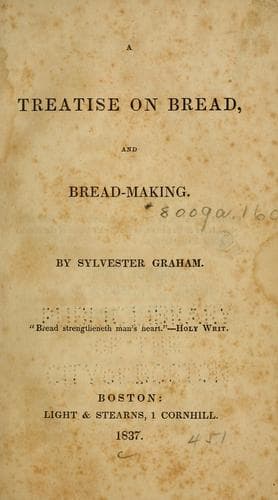
A Treatise on Bread, and Bread-making
Graham, Sylvester
Bread
In all these preparations of yeast and dough, it should ever be
recollected that “the process of fermentation cannot go on when the
temperature is below 30° F., that it proceeds quite slowly at 50°,
moderately at 60°, rapidly at 70°, and very rapidly at 80°.”
If, therefore, it is desired to have the yeast or dough stand several
hours before it is used or baked, it should be kept at a temperature of
about 50°. But in the ordinary way of making bread, a temperature
varying from 60° to 70°, or about summer heat, is perhaps as near right
as it can well be made.
Prof. Thomson gives the following directions for making yeast in large
quantities:—“Add ten pounds of flour to two gallons of boiling
water;—stir it well into a paste, let this mixture stand for seven
hours, and then add about a quart of good yeast. In about six or eight
hours, this mixture, if kept in a warm place, will have fermented and
produced as much yeast as will make 120 quartern loaves” (of 4 lbs.
each.)
A much smaller quantity can be made by observing due proportions of the
ingredients.
To raise bread in a very short time without yeast, Prof. Thomson gives
the following recipe:
“Dissolve in water 2 ounces, 5 drams and 45 grains of common
crystallized carbonate of soda, and mix the solution well with your
dough, and then add 7 ounces, 2 drams and 22 grains of muriatic acid of
the specific gravity of 1,121, and knead it as rapidly as possible with
your dough;—it will rise immediately—fully as much, if not more than
dough mixed with yeast—and when baked, will be a very light and
excellent bread.” Smaller quantities would be required for small batches
of bread.
A tea-spoonful or more (according to the quantity of dough or batter) of
super-carbonate of soda dissolved in water, and flour stirred in till it
becomes a batter, and then an equal quantity of tartaric acid dissolved
and stirred in thoroughly, will in a few minutes make very light batter
for griddle or pancakes; or if it be mixed into a thick dough, it will
make light bread.
Good lively yeast, however, makes better bread than these alkalies and
acids: howbeit these are very convenient in emergencies, when bread or
cakes must be prepared in a very short time; or when the yeast has
proved inefficient.
We see then that wheat meal consists of certain proportions of starch,
gluten, sugar, bran, &c.; and that in making loaf bread, we add yeast or
leaven, in order to produce that kind of fermentation peculiar to
saccharine matter or sugar, which is called vinous, and by which the gas
or air is formed that raises the dough. But the sugar is an incorporate
part of every particle of the meal, and is therefore equally diffused
throughout the whole mass; and hence if we would make the very best loaf
bread, the fermentive principle or yeast must also be equally diffused
throughout the whole mass, so that a suitable portion of yeast will be
brought to act at the same time on every particle of saccharine matter
in the mass.
Public-domain text, read in full here on John Shaqi.
Reviews
Reviews
No reviews yet
Be the first to share your thoughts on this work.
Join the Discussion
Join the discussion
Sign in to leave a comment or review.
Sign InorCreate an account