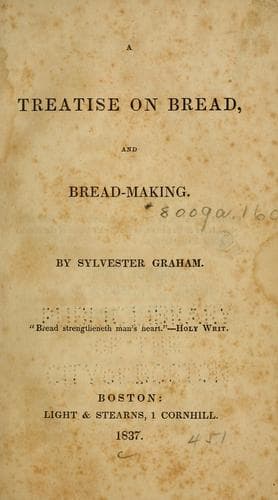
A Treatise on Bread, and Bread-makingGraham, Sylvester
History
A Treatise on Bread, and Bread-making
Graham, Sylvester
Bread
Nevertheless, I trust some good will be done by the little work I now
send out; and I am not without hope, that it will be the means of a
considerable improvement in the quality of bread, and, as a natural and
necessary consequence, an improvement in the health and happiness of
those who consume it.
That it may prove thus beneficial to my fellow creatures in a high
degree, is my hearty and fervent desire.
S. GRAHAM.
NORTHAMPTON, APRIL 12, 1837.
TREATISE ON BREAD.
HISTORY OF BREAD.
Primitive food of man. Bruising and grinding grain. Baking. Invention of
leavened bread. Bread among the Greeks and Romans—among the Hebrews.
Simplicity of the bread now used in many countries.
In the English version of the sacred scriptures, the term Bread is
frequently used to signify vegetable food in general. Thus in Gen. iii,
19, the Lord says to Adam—“In the sweat of thy face shalt thou eat bread
(or food) till thou return to the ground.” See also Gen. xviii, 5, and
xxviii, 20, and Ex. ii, 20.
The most extended sense of the word, however, according to general
usage, comprehends all farinaceous vegetable substances which enter into
the diet of man; such as the farinaceous seeds or grain, nuts, fruit,
roots, &c. And in this extended sense, Bread, in some form or other, has
been the principal article in the diet of mankind, from the earliest
generations of the human race, to the present time; except among the
few, small and scattered tribes, which have, perhaps, ever since the
days of Noah, in different parts of the earth, subsisted mainly on
animal food.
It is nearly certain that the primitive inhabitants of the earth, ate
their food with very little, if any artificial preparation.
The various fruits, nuts, seeds, roots, and other vegetable substances
on which they fed, were eaten by them in their natural state, with no
other grinding than that which was done by the teeth.
As the human family increased, and population became more dense and
extended, and providential measures more necessary, the condition and
circumstances of society gradually led to the invention and adoption of
the simple, and, at first, rude arts of domestic life. Among these, was
that of bruising the harder articles of their food, such as nuts and
seeds, or grain, on flat stones, selected and kept for the purpose. By
constant use, these stones in time became hollowed out; and being
thereby rendered more convenient, men at length began to form mortars
and pestles from stones; and probably the next step was the construction
of the rude kind of hand-mills, which continued in use for many
centuries; and indeed, which, with the stone mortars, have, throughout
all ages and in almost every portion of the earth, been used in the
ruder states of society.
Public-domain text, read in full here on John Shaqi.
Reviews
Reviews
No reviews yet
Be the first to share your thoughts on this work.
Join the Discussion
Join the discussion
Sign in to leave a comment or review.
Sign InorCreate an account