A Treatise on Bread, and Bread-making — John Shaqi
A Treatise on Bread, and Bread-makingGraham, Sylvester
History
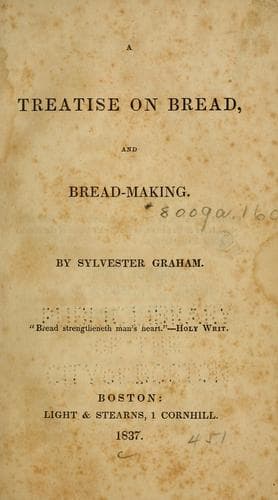
A Treatise on Bread, and Bread-making
Graham, Sylvester
Bread
When men became acquainted with the use of fire, they probably often
parched their corn or grain before they pounded it; and afterwards, they
learned to mix it with water into the consistency of dough, and to bake
this, in an unleavened or unfermented state, on flat stones before the
fire, or in the hot ashes or hot earth, or in the rude ovens which they
formed, by digging holes in the earth, into which they put heated
stones, and slightly covered them with leaves or grass, and then laid in
the article they wished to bake, and over this strewed some leaves, and
then covered the whole with earth.[A]
This kind of unleavened bread, undoubtedly constituted a very important,
if not the principal article of artificially prepared food in the diet
of the primitive inhabitants of the earth, for many centuries; and the
same, or very nearly the same kind of bread continued in general use
down to the days of Abraham; and it is probable that the unleavened
bread used by his descendants at the feast of the Passover, before and
after they left Egypt, was of the same kind.
It is hardly possible, however, that it could have been otherwise, than
that, at a much earlier period, larger quantities of this dough were
occasionally made, than were immediately baked, and consequently
portions of it were suffered to stand and ferment; and by this means,
men were in process of time learned to make leavened, or raised bread.
At how early a date, loaf or raised bread came into common use, it is
impossible now to ascertain with any considerable degree of precision.
The scriptures do not afford us any evidence that Abraham was accustomed
to such bread; but the fact that Moses, at the institution of the supper
of the Passover, the night before the Jews left Egypt, commanded them
strictly to abstain from leavened bread, and to eat only the unleavened,
proves conclusively, that the Israelites at least, were then accustomed
to fermented, or raised bread.
Neither history nor tradition enables us to speak with any degree of
confidence in regard to the period at which other nations became
acquainted with the art of bread-making; but from all that has come down
to us from ancient times, we learn that the primitive generations of
every nation, subsisted on fruits and other products of the vegetable
kingdom, in their uncooked or natural state.
“The Greeks assert that they were taught the art of making bread by
their god, Pan; and Pliny informs us that this art was not known at Rome
till near six hundred years after the foundation of that city. The Roman
armies, he says, on their return from Macedonia, brought Grecian bakers
into Italy. Before this time, the Romans prepared their meal in a kind
of pap or soft pudding; and on this account Pliny calls them pap
eaters.”
Public-domain text, read in full here on John Shaqi.
Reviews
Reviews
No reviews yet
Be the first to share your thoughts on this work.
Join the Discussion
Join the discussion
Sign in to leave a comment or review.
Sign InorCreate an account