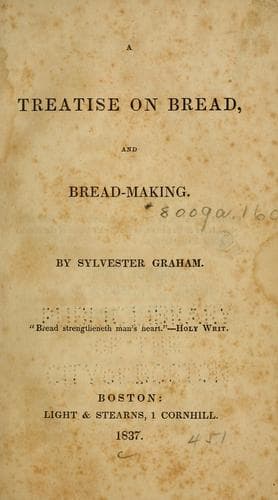
A Treatise on Bread, and Bread-makingGraham, Sylvester
History
A Treatise on Bread, and Bread-making
Graham, Sylvester
Bread
The vinous fermentation, therefore, by which the dough is raised and
made light, may be carried to all necessary extent, and still be limited
in its action to the saccharine matter or sugar—leaving the starch and
gluten, and other properties of the meal, uninjured; and this is the
point at which the fermentation should be arrested by the heat that
bakes the dough. If it be permitted to go beyond the sugar, and act on
the mucilage and starch, and produce acidity, the excellence of the
bread is in some degree irreparably destroyed. The acid may be
neutralized by pearlash or soda, so that the bread shall not be sour;
but still, something of the natural flavor of the bread is gone, and it
is not possible by any earthly means to restore it; and this injury will
always be in proportion to the extent to which the process of the
acetous fermentation is permitted to go in destroying the nature of the
starch, and the bread will be proportionably destitute of that natural
sweetness and delicious richness essential to good bread. Yet it is
almost universally true, both in public and domestic bread-making, that
the acetous fermentation is allowed to take place; and saleratus, or
soda, or some other chemical agent is employed to neutralize the acid.
By this means we may have bread free from acidity, it is true, but it is
also destitute of the best and most delicious properties of good bread;
and generally, by the time it is twenty-four hours old—and this is
particularly true of bakers’ bread—it is as dry and tasteless and
unsavory as if it were made of plaster of Paris.
Many bread-makers mix their saleratus or soda with their yeast, or
introduce it when they mix their dough, so that if the acetous
fermentation does take place, the acid is neutralized by the alkali, and
therefore, not being perceived, it is supposed never to have existed,
and the bread is called sweet and good; especially if a small quantity
of molasses be employed in making the dough. Others far more wisely
withhold their alkali till the dough is raised enough to mould into the
loaf, and then if it is found to be in any degree acid, a solution of
saleratus or soda is worked into it, so as just to neutralize the acid,
and no more. This is infinitely better that no have sour bread, which,
after all, is almost everywhere met with; yet the very best bread that
can be made in this way is only second best. Happy are they who can make
good light and sweet bread, without the use of molasses—without
suffering the least degree of acetous fermentation to take place, and
without employing saleratus, soda, or any other kind of alkali.
Public-domain text, read in full here on John Shaqi.
Reviews
Reviews
No reviews yet
Be the first to share your thoughts on this work.
Join the Discussion
Join the discussion
Sign in to leave a comment or review.
Sign InorCreate an account