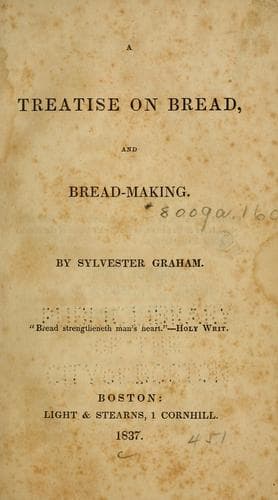
A Treatise on Bread, and Bread-makingGraham, Sylvester
History
A Treatise on Bread, and Bread-making
Graham, Sylvester
Bread
The third or putrefactive stage of fermentation rarely takes place in
domestic bread-making; but it is by no means uncommon in public
bakeries. Indeed it is thought necessary in the manufacture of certain
kinds of crackers, in order to make them split open, and render them
brittle, and cause them readily to become soft when dipped into water.
But dyspepsia crackers, and all other kinds of bread made in this way
are, to say the least of them, miserable stuff. For besides the fact
that all the best qualities of the flour or meal have been destroyed by
fermentation, the great quantity of alkali employed in neutralizing the
acid, is necessarily injurious to the digestive organs.
PREPARATION OF BREAD.
Mixing. Much kneading necessary. Rising, or fermentation. Use of
alkalies, saleratus and soda. Baking. Ovens. Alcohol in bread.
Preservation of bread.
Now, then, the business of the bread-maker is, to take the wheat meal,
prepared in the manner I have stated, and with all the properties I have
described, and convert it into good, light, sweet, well-baked bread,
with the least possible change in those properties; so that the bread,
when done, will present to the senses of smell and taste, all the
delicious flavor and delicate sweetness which pure organs perceive in
the meal of good new wheat, just taken from the ear and ground, or
chewed without grinding; and it should be so baked that it will, as a
general statement, require and secure a full exercise of the teeth in
mastication.
In order to do this, as we have seen, it is necessary, in the first
place, that the wheat should be of the best kind, and well cleansed, and
the meal properly prepared. In the next place, it is necessary that the
yeast should be fresh, lively and sweet; and in the third place, it is
necessary that the dough should be properly mixed, raised and baked.
Take then such a quantity of meal, in a perfectly clean and sweet bread
trough, as is necessary for the quantity of bread desired, and having
made a hollow in the centre, turn in as much yeast as a judgment matured
by sound experience shall deem requisite; then add such a quantity of
water, milk and water, or clear milk, as is necessary to form the meal
into a dough of proper consistency. Some prefer bread mixed with water
alone; others prefer that which is mixed with milk and water; and others
think that bread mixed with good milk is much richer and better; while
others dislike the animal odor and taste of bread mixed with milk.
Perhaps the very best and most wholesome bread is that which is mixed
with pure soft water, when such bread is made perfect. But whether
water, milk and water, or milk alone is employed, it should be used at a
temperature of about blood heat.
Public-domain text, read in full here on John Shaqi.
Reviews
Reviews
No reviews yet
Be the first to share your thoughts on this work.
Join the Discussion
Join the discussion
Sign in to leave a comment or review.
Sign InorCreate an account