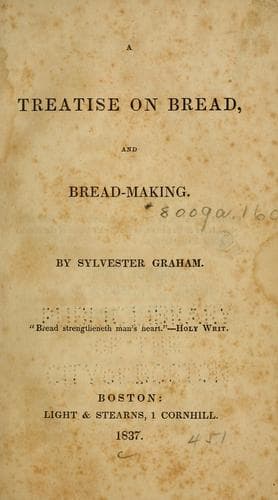
A Treatise on Bread, and Bread-makingGraham, Sylvester
History
A Treatise on Bread, and Bread-making
Graham, Sylvester
Bread
But are we to look for such a sensibility in public bakers? Can we
expect that they will feel so lively and so strong an interest for our
enjoyment and for our physical and intellectual and moral well-being,
that they will exercise all that care and attention and patience, and
watch with that untiring vigilance and solicitude in all the progress of
their operations, which are indispensably necessary in order to secure
us the best of bread?
Or can we reasonably expect to find these qualifications in domestics—in
those who serve us for hire? Many a female domestic, it is true, can
make much better bread than her mistress can. Many a female domestic has
an honest and sincere desire to do her duty faithfully; but can she be
actuated by those sensibilities and affections which alone can secure
that careful attention, that soundness of judgment, that accuracy of
operation, without which the best of bread cannot uniformly, if ever, be
produced?
No;—it is the wife, the mother only—she who loves her husband and her
children as woman ought to love, and who rightly perceives the relations
between the dietetic habits and physical and moral condition of her
loved ones, and justly appreciates the importance of good bread to their
physical and moral welfare—she alone it is, who will be ever inspired by
that cordial and unremitting affection and solicitude which will excite
the vigilance, secure the attention, and prompt the action requisite to
success, and essential to the attainment of that maturity of judgment
and skilfulness of operation, which are the indispensable attributes of
a perfect bread-maker. And could wives and mothers fully comprehend the
importance of good bread in relation to all the bodily and intellectual
and moral interests of their husbands and children, and in relation to
the domestic and social and civil welfare of mankind, and to their
religious prosperity, both for time and eternity, they would estimate
the art and duty of bread-making far, very far more highly than they now
do. They would then realize that, as no one can feel so deep and
delicate an interest for their husbands’ and children’s happiness as
they do, so no one can be so proper a person to prepare for them that
portion of their aliment, which requires a degree of care and attention
that can only spring from the lively affections and solicitude of a wife
and mother.
But it is a common thing to hear women say—“We cannot always have good
bread, if we take ever so much pains;—it will sometimes be heavy, and
sometimes be sour, and sometimes badly baked, in spite of all our care.”
Public-domain text, read in full here on John Shaqi.
Reviews
Reviews
No reviews yet
Be the first to share your thoughts on this work.
Join the Discussion
Join the discussion
Sign in to leave a comment or review.
Sign InorCreate an account