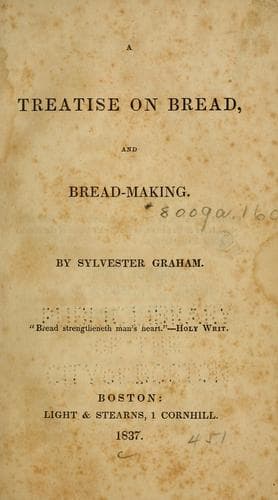
A Treatise on Bread, and Bread-makingGraham, Sylvester
History
A Treatise on Bread, and Bread-making
Graham, Sylvester
Bread
If in baking, the outer crust should become a little too dry and crispy,
you can easily remedy this by throwing a clean bread or table cloth over
it for a short time when it first comes from the oven; but if this is
not necessary, let the bread stand on an airy shelf, till it becomes
perfectly cool, and when it is twenty-four hours old, it is fit for use;
and if it is in all respects properly made, and properly kept, it will
continue to be sweet and delicious bread for two or even three weeks,
except perhaps in very hot and sultry weather.
When we have acquired the art of making such bread as I have described,
in the very best manner, then have we carried the art of cooking to the
very height of perfection; for it is not only true, that there is no
other artificially prepared article in human diet of so much importance
as bread, but it is also true that there is no other preparation in the
whole round of cooking, which requires so much care, and attention, and
experience, and skill, and wisdom.
WHO SHOULD MAKE BREAD.
Making bread by rule. Bakers. Domestics. Sour bread. An anecdote. Mrs.
Van Winkle. Bad bread need not be made. How cake is made. Bread-making
a drudgery. Excellent example of a mother. Eating bad bread.
Importance of having good bread.
Who then shall make our bread? For after all that science in its utmost
accuracy can do, in ascertaining principles and in laying down rules,
there is little certainty that any one, who undertakes to make bread
merely by rule, will be anything like uniformly successful. We may make
a batch of bread according to certain rules, and it may prove excellent;
and then we may make another batch according to the same rules, which
may be very poor. For if we follow our rules ever so closely, there may
be some slight differences in the quality or condition of the meal or
the yeast, or something else, which will materially alter the character
of the bread, if we do not exercise a proper care and judgment, and vary
our operations according as the particular circumstances of the case may
require.
Correct rules are certainly very valuable; but they can only serve as
general way-marks, in the art of bread-making. Uniform success can only
be secured by the exercise of that mature judgment which is always able
to dictate those extemporaneous measures which every exigency and
circumstance may require; and such a judgment can only result from a
care and attention and experience which are the offspring of that moral
sensibility which duly appreciates the importance of the quality of
bread, in relation to the happiness and welfare of those that consume
it.
Public-domain text, read in full here on John Shaqi.
Reviews
Reviews
No reviews yet
Be the first to share your thoughts on this work.
Join the Discussion
Join the discussion
Sign in to leave a comment or review.
Sign InorCreate an account