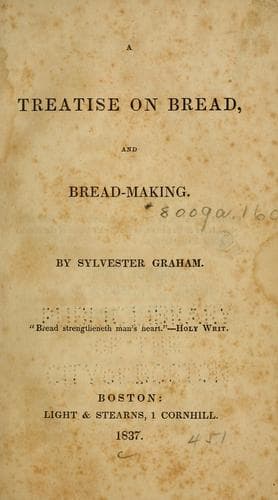
A Treatise on Bread, and Bread-making — John Shaqi
A Treatise on Bread, and Bread-makingGraham, Sylvester
History
A Treatise on Bread, and Bread-making
Graham, Sylvester
Bread
If in the midst of this employment some one knocks or rings at the door,
and a young gentleman is announced, she is not at all embarrassed, but
perhaps hastens to the parlor with her delicate hands covered with
dough, and with an air of complacency and self-satisfaction, says—“Good
morning, Frank—how do you do? I am just engaged in making some cake—I
hope you will excuse me for a few moments.”
All this shows that she regards the quality of her cake as of very great
importance, and considers it not only perfectly respectable but highly
_genteel_, for a young lady to be employed in making cake. But in regard
to bread and bread-making, everything is very different; there is none
of this early curiosity to learn how to make good bread. Young ladies do
not on every occasion when they find excellent bread, carefully and
minutely inquire how it was made, baked, &c., and write down the
recipe;—but when a batch of bread is to be made for the family, they
either leave it for Mother or some domestic to make, or go about it
themselves as some irksome and disreputable piece of drudgery; and
consequently they turn the task off their hands with as much despatch
and as little trouble as possible. If all things happen to be as they
should be, it is well; if not, they must answer for the present. If the
yeast happens to be lively and sweet, very lucky. If otherwise, still it
must be used. If the dough rises well and is got into the oven before it
becomes sour, very fortunate; if not, why, “nobody can avoid
mistakes—and bread will sometimes be poor in spite of the greatest
care;”—and if a batch of miserable bread is the result of such an
operation, then all that remains to be done is to eat it up as soon as
possible, and hope for better the next time.
If Frank or Charles or Edward should call while the young lady is
engaged in making bread, she is perhaps quite disconcerted, and would
not for the world have him know what she is doing;—she sends word to
him, either that she is out, or that she is particularly engaged, and
begs he will excuse her;—or if by any means she happens unexpectedly to
be caught at her employment, she is greatly embarrassed, and makes the
best apology she can for being engaged in such menial services.
As a matter of course, while such are the views and feelings entertained
on this subject, and while such is the manner in which this duty is
performed, it will ever be a mere accident if good bread is made; and a
mere accident if such girls ever become good bread-makers when they are
wives and mothers.
Public-domain text, read in full here on John Shaqi.
Reviews
Reviews
No reviews yet
Be the first to share your thoughts on this work.
Join the Discussion
Join the discussion
Sign in to leave a comment or review.
Sign InorCreate an account