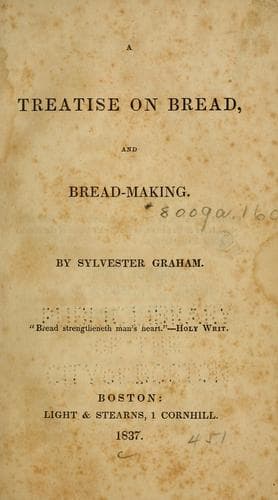
A Treatise on Bread, and Bread-makingGraham, Sylvester
History
A Treatise on Bread, and Bread-making
Graham, Sylvester
Bread
But if parents, and especially mothers, could view this matter in its
true light, how differently would they educate their children. They
would then feel that, grateful as it is to a mother’s heart to see her
daughters highly refined and elegantly accomplished, and able to “make
the instrument discourse most eloquent music,” and to transfer living
nature, with all its truth and beauty and sublimity, to the canvass,
still the art of bread-making, when considered in all its relations and
intimate connections with human health, and prosperity, and virtue, and
happiness, and with reference to the natural responsibilities and duties
of woman, is actually one of the highest and noblest accomplishments
that can adorn the female character. And then, too, would they consider
it of exceedingly great importance, that their daughters should possess
this accomplishment, even though they may never be in circumstances
which will require the exercise of it.
Some eight or nine years since, I spent several months in the delightful
village of Belvidere, on the banks of the Delaware, in Pennsylvania.
While there, I enjoyed for a number of weeks the kind hospitality of S―
S―, Esq., a lawyer, and a gentleman of great moral excellence. Mrs. S.
was born and brought up, I believe, in Philadelphia. Her father was a
man of wealth, and she was the only daughter, and—almost as a matter of
course—was indulged in all that she desired. But there were so many of
the elements of a good wife and mother in her natural composition, that
as soon as she entered into those interesting and important relations,
she began to devote herself to the duties of them with a sincerity and
conscientiousness which could not fail of success. Surrounded as she
was, with wealth, and every comfort and convenience of life, and all of
its luxuries that she desired, still she was industrious in her habits,
and vigilantly attentive to all the concerns of her household. She
usually kept three female domestics, who, by her kind maternal
deportment towards them, were warmly attached to her. She had no
difficulty in procuring nor in keeping help, because she always treated
them in such a manner that they loved to stay with her; and she took
much pains to qualify them for the proper discharge of their duties.
They evidently loved her, and were sincerely desirous of performing all
their services in such a manner as would be pleasing to her. Yet with
all these advantages to justify her leaving such a duty to her
domestics, Mrs. S. invariably made the family bread with her own hands.
Regularly as the baking day came, she went into her kitchen and took her
stand beside the bread trough, and mixed and kneaded the dough, and put
it in its proper place for rising, and, in due time, moulded it into the
loaf and baked it.
Do you always make your bread, madam? I inquired one day, as she
returned from the performance of that task. “Invariably,” she replied:
“that is a duty I trust no other person to do for me.”
Public-domain text, read in full here on John Shaqi.
Reviews
Reviews
No reviews yet
Be the first to share your thoughts on this work.
Join the Discussion
Join the discussion
Sign in to leave a comment or review.
Sign InorCreate an account