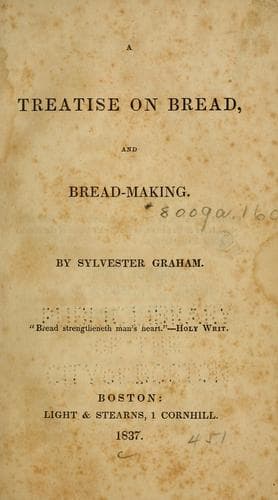
A Treatise on Bread, and Bread-makingGraham, Sylvester
History
A Treatise on Bread, and Bread-making
Graham, Sylvester
Bread
Rye bread. Indian meal bread. Use of sour milk, or butter-milk. Acids.
Family grinding.
I have thus far spoken almost entirely of wheaten bread, because I
consider that the most wholesome kind of bread for ordinary use—for
“daily bread.” When bread is made of superfine flour, the same general
rules should be observed.
Rice, barley, oats, rye, Indian corn, and many other farinaceous
products of the vegetable kingdom, may also be manufactured into bread,
but none of them will make so good bread as wheat. Good rye, raised on a
sandy soil, when cleansed and ground in the manner I have already
described, and prepared in all respects according to the rules I have
laid down, will make very excellent bread. Rye, coarsely ground, without
bolting, and mixed with Indian meal, makes very wholesome bread, when it
is well made. Good rye and Indian bread is far more wholesome for common
or every-day use, than that made of superfine flour.
There are various ways of preparing Indian meal bread; and when such
bread is well made, it is very wholesome—much more so, for every-day
use, than superfine flour bread. “In a memoir lately read before the
French Academy,” says the Journal of Health, “the author undertook to
show that maize (Indian corn) is more conducive to health than any other
grain; and, as a proof of this, the fact was adduced that, in one of the
departments in which this grain was most abundantly and universally
used, the inhabitants were remarkable for their health and vigor.”
One great drawback to the wholesomeness of Indian meal bread, however,
is, that it is almost universally eaten hot, and too generally, pretty
well oiled with butter, or some other kind of animal fat or oil. But
Indian meal bread can be prepared in such a manner as to obviate these
difficulties, and render it very wholesome.
Barley and oats may be manufactured into very wholesome bread; but they
are little used for such purposes in this country.
Rice, peas, beans, potatoes, &c., may also, by mixing them with a
portion of wheat or rye flour, be manufactured into bread; but, as I
have already stated, there is no other kind of grain or farinaceous
vegetable substance from which so good loaf bread can be made, as good
wheat.
In making bread from Indian meal, and other kinds of farinaceous
substances containing little or no gluten, yeast or leaven is rarely if
ever used to make it light. More generally sour milk or butter-milk and
saleratus or soda are used for this purpose; and they who do not well
understand the principle upon which these substances make their bread
light, often greatly impair their own success by their mismanagement.
It is, perhaps, most common for them to mix their sour milk or
butter-milk and saleratus together, and wait till the effervescence is
over, before they stir in their meal. But by this means they lose the
greater part of the gas or air by which their dough should be made
light.
Public-domain text, read in full here on John Shaqi.
Reviews
Reviews
No reviews yet
Be the first to share your thoughts on this work.
Join the Discussion
Join the discussion
Sign in to leave a comment or review.
Sign InorCreate an account