A Treatise on Bread, and Bread-making — John Shaqi
A Treatise on Bread, and Bread-makingGraham, Sylvester
History
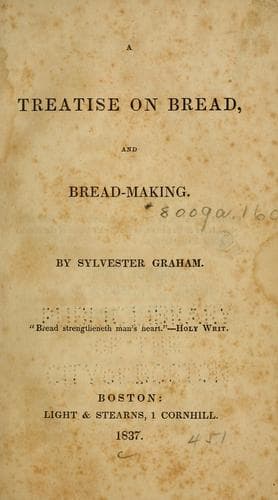
A Treatise on Bread, and Bread-making
Graham, Sylvester
Bread
It was observed many years ago, by one of the most eminent and extensive
practitioners in New England, that, during a practice of medicine for
thirty years, he had always remarked that, in those families where the
children were most afflicted with worms, he invariably found poor bread;
and that, as a general fact, the converse of this was true; that is, in
those families where they uniformly had heavy, sour, ill-baked bread, he
generally found that the children were afflicted with worms.
A careful and extensive observation for a few years, would convince
every intelligent mind that there is a far more intimate relation
between the quality of the bread and the moral character of a family,
than is generally supposed.
“Keep that man at least ten paces from you, who eats no bread with his
dinner,” said Lavater, in his “Aphorisms on Man.” This notion appears to
be purely whimsical at first glance; but Lavater was a shrewd observer,
and seldom erred in the moral inferences which he drew from the
voluntary habits of mankind; and depend upon it, a serious contemplation
of this apparent whim, discloses a deeper philosophy than is at first
perceived upon the surface.
Whatever may be the cause which turns our children and ourselves away
from the dish of bread, and establishes an habitual disregard for it,
the effect, though not perhaps in every individual instance, yet, as a
general fact, is certainly, in some degree, unfavorable to the physical,
and intellectual, and moral, and religious, and social, and civil and
political interests of man.
Of all the artificially prepared articles of food which come upon our
table, therefore, bread should be that one which, as a general fact, is
uniformly preferred by our children and our household,—that one, the
absence of which they would notice soonest, and feel the most,—that one
which—however they may enjoy for a time the little varieties set before
them—they would be most unwilling to dispense with—and which, if they
were driven to the necessity, they would prefer to any other dish, as a
single article of subsistence.
To effect this state of things, it is obvious that the quality of the
bread must be uniformly excellent; and to secure this, I say again,
there must be a judgment, an experience, a skill, a care, a vigilance,
which can only spring from the sincere affections of a devoted wife and
mother, who accurately perceives and duly appreciates the importance of
these things, and, in the lively exercise of a pure and delicate moral
sense, feels deeply her responsibilities, and is prompted to the
performance of her duties.
Would to God that this were all true of every wife and mother in our
country—in the world!—that the true relations, and interests, and
responsibilities of life were understood and felt by every human being,
and all the duties of life properly and faithfully performed!
VARIETIES OF BREAD.
Public-domain text, read in full here on John Shaqi.
Reviews
Reviews
No reviews yet
Be the first to share your thoughts on this work.
Join the Discussion
Join the discussion
Sign in to leave a comment or review.
Sign InorCreate an account