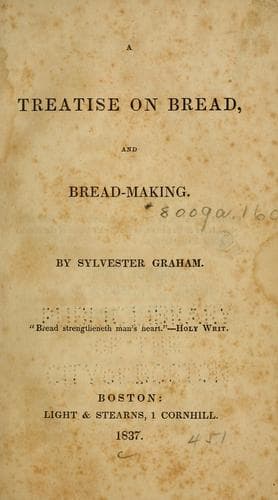
A Treatise on Bread, and Bread-makingGraham, Sylvester
History
A Treatise on Bread, and Bread-making
Graham, Sylvester
Bread
If man were to subsist wholly on alimentary substances in their natural
state, or without any artificial preparation by cooking, then he would
be obliged to use his teeth freely in masticating his food; and by so
doing, not only preserve his teeth from decay, and keep them in sound
health, but at the same time, and by the same means, would he thoroughly
mix his food with the fluid of his mouth, and thus prepare it both for
swallowing and for the action of the stomach, and by the same means
also, he would be made to swallow his food slowly, as the welfare of the
stomach and of the whole system requires he should.
Again, if man were to subsist wholly on uncooked food, he would never
suffer from the improper temperature of his aliment. Hot substances
taken into the mouth, serve more directly and powerfully to destroy the
teeth, than any other cause which acts immediately upon them; and hot
food and drink received into the stomach, always in some degree
debilitate that organ, and through it, every other organ and portion of
the whole system; diminishing, as an ultimate result, the vital power of
every part—impairing every function, and increasing the susceptibility
of the whole body to the action of disturbing causes, and predisposing
it to disease. Again, if man were to subsist entirely on food in a
natural state, he would never suffer from concentrated aliment. Every
substance in nature which God has prepared for the food of man, consists
of both nutritious and innutritious matter. The proportions vary in
different kinds of food. Thus in a hundred pounds of potatoes, there are
about twenty-five pounds of nourishing matter; while in a hundred pounds
of good wheat there are about eighty pounds of nourishing matter. There
are a few products of the vegetable kingdom which are still higher in
the scale of nutriment, than wheat; and on the other hand there is a
boundless variety ranging below wheat, extending down to three or four
per cent. of nourishment. But nature, without the aid of human art,
produces nothing for the alimentary use of man which is purely a
concentrated nutrient substance. And God has constructed man in strict
accordance with this general economy of nature. He has organized and
endowed the human body with reference to the condition and qualities of
those substances in nature, which He designed for the food of man. And
consequently, while man obeys the laws of constitution and relation
which should govern him in regard to his food, he preserves the health
and integrity of his alimentary organs, and through them of his whole
nature; and so far as his dietetic habits are concerned, secures the
highest and best condition of his nature. But, if he disregards these
laws, and by artificial means greatly departs from the natural
adaptation of things, he inevitably brings evil on himself and on his
posterity.
Public-domain text, read in full here on John Shaqi.
Reviews
Reviews
No reviews yet
Be the first to share your thoughts on this work.
Join the Discussion
Join the discussion
Sign in to leave a comment or review.
Sign InorCreate an account