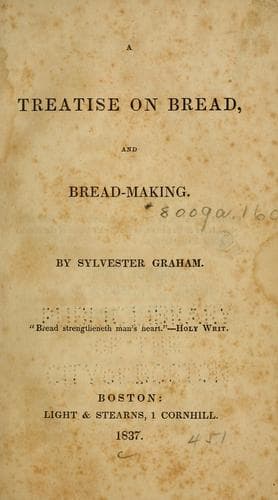
A Treatise on Bread, and Bread-makingGraham, Sylvester
History
A Treatise on Bread, and Bread-making
Graham, Sylvester
Bread
But though the Egyptians and Israelites were probably among the earliest
portions of the human family, who became acquainted with the art of
making loaf or raised bread, the quality of their bread continued to be
exceedingly simple and coarse for many generations.
Even after the establishment of the Hebrew nation in Palestine—in the
most splendid days of Jerusalem—at the period of the highest refinement
of the Jews, in the arts of civil and domestic life, their fine flour,
from which their choicest bread and cakes were made, was, in comparison
with modern superfine flour, extremely coarse,—ground mostly by females,
in hand-mills constructed and kept for that purpose.
From Rome the art of bread-making very slowly found its way over
considerable portions of Europe. A thousand years after Julius Cæsar
first entered Britain, the rude people of that country were little
acquainted with raised bread. “Even at present,” says Prof. Thomson,
“loaf bread is seldom used except by the higher classes of inhabitants,
in the northern countries of Europe and Asia.”
In Eastern and Southern Asia, rice constitutes the principal
bread-stuff; and this is generally prepared with great simplicity. In
Middle and Western Asia, and in Africa, bread, though made of different
kinds of grain, is prepared with almost equal simplicity. In Scotland,
Ireland, and indeed throughout Europe generally, barley, oats, rye,
potatoes, peas, beans, chesnuts, and other farinaceous vegetables,
constitute the bread-stuff of most of the laboring people, or peasantry.
In the islands of the Pacific and Southern oceans, the bread of the
inhabitants consists of the plantain, bananas, yams, bread-fruit, and
other like vegetables, simply roasted, baked, or boiled.
Bread, therefore, of some kind or other, made of some of the farinaceous
products of the vegetable kingdom, has probably, in almost every portion
of the world, and every period of time, been one of the first, and most
important, and universal articles of food, artificially prepared by
cooking, which has entered into the diet of mankind; and hence it has
with great propriety been called “the staff of life.”
LAWS OF DIET.
Reasons why food in its natural state would be the best. Concentrated
nutriment. Interesting experiments on animals. Mixtures of food.
Leavened and unleavened bread. Qualifications of the best bread.
Public-domain text, read in full here on John Shaqi.
Reviews
Reviews
No reviews yet
Be the first to share your thoughts on this work.
Join the Discussion
Join the discussion
Sign in to leave a comment or review.
Sign InorCreate an account