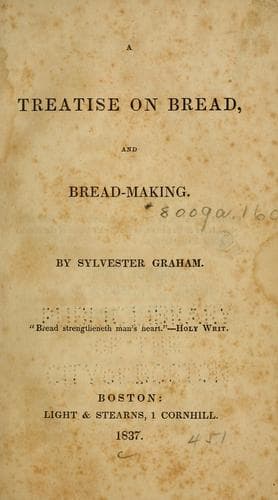
A Treatise on Bread, and Bread-makingGraham, Sylvester
History
A Treatise on Bread, and Bread-making
Graham, Sylvester
Bread
Again, if man subsisted wholly on uncooked food, he would not only be
preserved from improper concentrations, but also from pernicious
combinations of alimentary substances. The alimentary organs of man,
like those of the horse, ox, sheep, dog, cat, and most or all other
animals of the higher orders, if not in fact, of all other animals
without limitation, possess the vital capability of so accommodating
themselves to emergencies, that they can be made to digest almost every
vegetable and animal substance in nature; and they can, by long
training, be educated to digest a mixture of these substances at the
same time. Nevertheless it is incontestibly true, that the alimentary
organs of man and of all other animals, can manage one kind of food at a
time better than a mixed ingestion; for it is impossible that the
solvent fluids secreted by the stomach and other organs belonging to the
alimentary apparatus, should be at the same time equally well adapted to
entirely different kinds of food.
I do not say that the alimentary organs of man cannot, by long habit, be
brought into such a condition as that, while that condition remains,
they will not manage a mixed ingestion of animal and vegetable food,
with more immediate comfort and satisfaction to themselves and the
individual, than they will an ingestion of pure vegetable food. But this
does not militate against the general principle in the least; for it is
nevertheless true, that the same organs are capable of being brought
into a condition in which they will manage an ingestion of unmixed food
of either kind, with less embarrassment and injury to themselves and the
whole system, than they can the mixed food in any condition. Hence it is
a general law of nature, concerning the dietetic habits of man, that
simplicity of food at each meal is essential to the highest well-being
of the individual and of the race.
God has unquestionably provided a great and rich variety of substances
for man’s nourishment and enjoyment; but it is equally certain that he
did not design that man should partake of all this variety at a single
meal, nor in a single day, nor season—but from meal to meal, from day to
day, and from season to season, varying his enjoyment in strictest
consistency with the great laws of his nature. And hence all artificial
combinations of alimentary substances, and particularly those of a
heterogeneous kind, and yet more especially the concentrated forms, must
be more or less pernicious to the alimentary organs, and through them to
the whole system.
Finally, if man subsisted wholly on uncooked food, the undepraved
integrity of his appetite, his thorough mastication and slow swallowing,
and his simple meal, would greatly serve to prevent his overeating, and
thus save him from the ruinous effects of one of the most destructive
causes operating in civic life.
Public-domain text, read in full here on John Shaqi.
Reviews
Reviews
No reviews yet
Be the first to share your thoughts on this work.
Join the Discussion
Join the discussion
Sign in to leave a comment or review.
Sign InorCreate an account