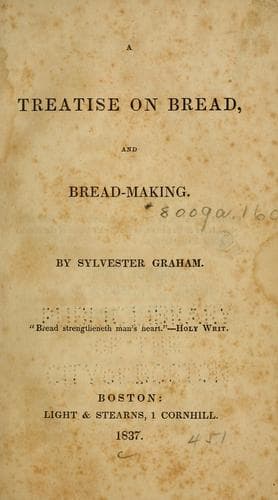
A Treatise on Bread, and Bread-makingGraham, Sylvester
History
A Treatise on Bread, and Bread-making
Graham, Sylvester
Bread
Whatever may be the material, therefore, from which bread is made, when
the artificial preparation is of that simple character which leaves the
proportions of nutritious and innutritious properties, as nature
combined them, and effects little change in the nutritious principles,
and retains the natural requisition for the function of the teeth, and
thus secures the proper chewing of the food and the mixing of it with
the fluids of the mouth, and swallowing of it slowly, the artificial
process militates very little, if at all, against any of the
physiological or vital interests of the body. But if our artificial
process of bread-making, concentrates the nutrient properties, and
destroys the due proportion between the bulk and nourishment, and forms
improper changes and combinations in the nutrient elements, and does
away the necessity for mastication or chewing, and presents the food in
too elevated a temperature, or too hot, and enables us to swallow it too
rapidly, with little or no exercise of the teeth, and without properly
mixing it with the fluids of the mouth, the artificial process or
cooking is decidedly and often exceedingly inimical, not only to the
vital interests of the alimentary organs, but of the whole human system.
In all civilized nations, and particularly in civic life, bread, as I
have already stated, is far the most important article of food which is
artificially prepared; and in our country and climate, it is the most
important article that enters into the diet of man; and therefore it is
of the first consideration, that its character should, in every respect,
be as nearly as possible, consistent with the laws of constitution and
relation established in our nature; or with the anatomical construction
and vital properties and powers and interest of our systems.
If we contemplate the human constitution in its highest and best
condition,—in the possession of its most vigorous and unimpaired
powers—and ask, what must be the character of our bread in order to
preserve that constitution in that condition? the answer most
indubitably is, that the coarse unleavened bread of early times, when of
proper age, was one of the least removes from the natural state of
food,—one of the simplest and most wholesome forms of artificial
preparations, and best adapted to fulfil the laws of constitution and
relation; and therefore best adapted to sustain the most vigorous and
healthy state of the alimentary organs, and the highest and best
condition of the whole nature of man, as a general and permanent fact;
and hence it is very questionable whether loaf or raised bread can be
made equally conducive to all the interests of our nature, with the
simple unleavened bread.
Public-domain text, read in full here on John Shaqi.
Reviews
Reviews
No reviews yet
Be the first to share your thoughts on this work.
Join the Discussion
Join the discussion
Sign in to leave a comment or review.
Sign InorCreate an account