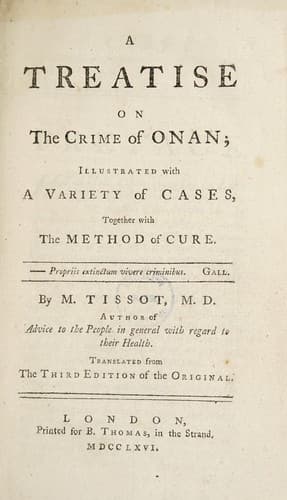
A Treatise on the Crime of Onan: Illustrated with a Variety of Cases, Together with the Method of Cure — John Shaqi
A Treatise on the Crime of Onan: Illustrated with a Variety of Cases, Together with the Method of CureTissot, S. A. D. (Samuel Auguste David)
Science
A Treatise on the Crime of Onan: Illustrated with a Variety of Cases, Together with the Method of Cure
Tissot, S. A. D. (Samuel Auguste David)
Masturbation -- Early works to 1800; Sexual ethics -- Early works to 1800
“It is (says M. HALLER) a most violent action, bordering upon convulsion,
and which must therefore astonishingly weaken, being detrimental to the
nervous system.”
It has been seen, in an observation precedently set forth, that an
emission was preceded by actual convulsions, by a sort of epilepsy; and
the same observation furnishes evident proof of the influence which those
violent emotions had on the unhappy man who was subjected to them.
The immediateness of the faintness after the act has to many appeared,
and not without reason, a proof, that it could not be only the privation
of the seed that occasioned it; but what demonstratively proves how much
the spasm or convulsion must weaken, is the weakness incident to those
who are afflicted with convulsive disorders: that which follows the fits
of epilepsy is sometimes excessive.
It could be only to the spasm, or convulsion, that the singular effect
was to be imputed, which coition had on one whose name was AMMAN, and
whose history was preserved to us by PLATERUS. Being advanced in years he
had re-married, and being about to consummate his nuptials, he was seized
with so violent a suffocation, that he was obliged to discontinue the
attempt. The same accident returned every time that he renewed the trial.
He applied, upon this, to a number of quacks. One of them, who had made
him take a great many of his pretended remedies, assured him that he had
no longer any danger to fear. On the faith of his Æsculapius, he ventured
upon a fresh attempt. The same symptom was instantly the consequence:
however, full of confidence, he would persist, and died in the act
itself, in the arms of his wife[63].
Those violent palpitations which sometimes accompany that of coition,
are also a convulsive symptom. HIPPOCRATES speaks of a young man, to
whom excesses of venery and wine had occasioned, among other symptoms,
continual palpitations[64]. And DOLÆUS knew one, who, in the act itself,
was seized with so violent a palpitation, that he must have been
suffocated if he had persisted[65].
The case of the child, above quoted, is also a proof, (which did not
escape the sagacity of M. RAST,) of the power of the convulsive cause;
since at that age he could hardly evacuate any thing but the humor of the
prostates, and not genuine seed.
These remarks have fallen under the observation of a number of good
authors, who have written upon this matter. GALEN seems to have hit upon
them, where he says, “Pleasure itself weakens the vital forces.”
Mr. FLEMING has not omitted the cause, in his fine poem on the maladies
of the nerves:
_Quin etiam nervos frangit quæcunque voluptas_[66].
Public-domain text, read in full here on John Shaqi.
Reviews
Reviews
No reviews yet
Be the first to share your thoughts on this work.
Join the Discussion
Join the discussion
Sign in to leave a comment or review.
Sign InorCreate an account