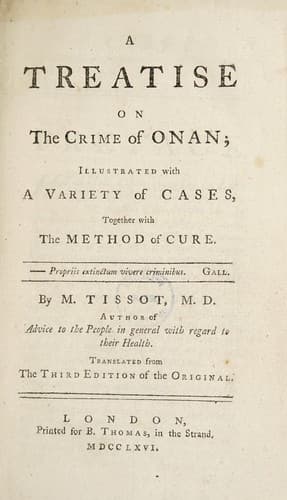
A Treatise on the Crime of Onan: Illustrated with a Variety of Cases, Together with the Method of CureTissot, S. A. D. (Samuel Auguste David)
Science
A Treatise on the Crime of Onan: Illustrated with a Variety of Cases, Together with the Method of Cure
Tissot, S. A. D. (Samuel Auguste David)
Masturbation -- Early works to 1800; Sexual ethics -- Early works to 1800
SANCTORIUS positively establishes his assertion, that the motions weaken
more than the emission of the seed: and it is surprising that M. DE
GORTER, his commentator, should have sought to persuade the contrary. The
reason which he gives, in his averment that these motions do not weaken
any more than any other motion, “_because they are not convulsive_,”[67]
will persuade no one. One example, could he produce it, would not pass
for a law of nature. LISTER, NOGUEZ, QUINCY, who had commented this work
before him, are not of his opinion; they attribute part of the danger to
the weakness that remains after the convulsions. “Coition (says NOGUEZ)
is itself a convulsion; it disposes the nerves to convulsive motions, and
the slightest occasion consequently produces them.”
J. A. BORELLI, one of the first creators of physiology, had not looked
upon them in the same light as M. GORTER. He is clearly positive upon
this article.
“This act (says he) is accompanied with a sort of convulsive pathos,
which carries with it the most sensible affections of the brain, and of
the whole nervous system[68].”
Mr. SENAC specifically imputes to the nerves the weakness which follows
coition.
“The most likely cause (says he) of the fainting fit which comes when
an abscess breaks in the interior of the abdomen, is the action of the
nerves then brought into play. This is confirmed by the ejection, or by
the fits of faintness which follow the effusion of seed; for it is only
to the nerves that this sinking can be imputed[69].”
M. LEWIS[70] attributes more to this cause than to the other, in which
he is of the opinion of SANCTORIUS. Where there is convulsion, the
nervous system is in a state of tension, or, to say more correctly, in
an extraordinary degree of action, of which the necessary consequence is
an excessive relaxation. Every organ, that has been wound up beyond its
natural pitch, falls beneath it; and from that very fall must necessarily
result a bad performance of the functions which depend on it; and as the
nerves have an influence over them all, there is not one of the functions
but what must be more or less disordered when the nerves are weakened.
One reason, too, that may contribute to the weakness of the nervous
system, is the augmentation of the quantity of blood in the brain,
during the venereal act; an augmentation well demonstrated, and which
has gone sometimes so far as to produce an apoplexy. Many examples of it
are furnished by observing practitioners, and HOFFMAN relates one of a
soldier, who, in the rage of lust with which he abandoned himself to this
act, died apoplectic in the very instant of fruition. On being opened,
the brain was found full of blood. It is by this augmentation of blood,
that the reason is explained of those excesses producing madness[71].
Such a quantity of blood distending the nerves, enfeebles them: they can
the less resist impressions, and thence their weakness.
Public-domain text, read in full here on John Shaqi.
Reviews
Reviews
No reviews yet
Be the first to share your thoughts on this work.
Join the Discussion
Join the discussion
Sign in to leave a comment or review.
Sign InorCreate an account