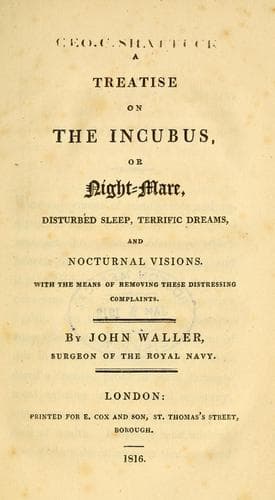
A Treatise on the Incubus, or Night-Mare, Disturbed Sleep, Terrific Dreams and Nocturnal VisionsWaller, John Augustine
HistoryChristian
A Treatise on the Incubus, or Night-Mare, Disturbed Sleep, Terrific Dreams and Nocturnal Visions
Waller, John Augustine
Nightmares; Sleep disorders
It is only however in the advanced stage of the disease, that this severe
struggle takes place. In the general way the patient is instantly
liberated from the paroxysm, as soon as he can succeed in moving any of
his limbs. I have seldom met with any one who was able to articulate
during the paroxysm, though I have generally been able myself to call any
person by name, who might be near me, and to beg of them to wake me, but
this is always effected with difficulty, and only after the paroxysm has
already continued some time.
4th. It frequently happens, especially when a person is anxious about
rising at a particular hour, and afraid of over-sleeping it, that he
becomes conscious of that circumstance in his sleep, and feels an ardent
desire to wake himself; to many persons this is by no means a difficult
task, and is soon accomplished; but to those who are subject to
Night-Mare, the reverse of this takes place. They strive with all their
might to awake, and soon become conscious of their precise circumstances,
but cannot recover the power of volition; after contending for this a
short time, the breathing at length becomes laborious, and a complete
paroxysm of Night-Mare succeeds, which always is severe in proportion as
the patient happens to be more perfectly awake.
From these observations it results, that the nature of Incubus is
essentially different to that of either sleeping or waking, and is an
absolute state of disease which may occur during sleep in a slight degree,
without breaking that sleep; that it consists in a suspension of the power
of volition very different to what takes place in natural sleep, because
it is accompanied with a consciousness of that suspension, and a strong
desire of recovering this power. But neither is this sufficient to
constitute Night-Mare, although this disease will, I believe always,
result from such a state of things, yet the paroxysm is by no means
complete, until, in addition to the general paralysis of all the muscles
of voluntary motion, there shall occur likewise a partial paralysis of
some of those concerned in the functions, which are performed
independently of the will, especially of respiration and the circulation
of the blood, the consequence of which will be a difficulty of breathing,
with a sense of oppression about the præcordia, and fluttering of the
heart. I conceive these symptoms to arise principally from a temporary
paralysis of the nerves of the diaphragm; or rather an inaptitude in those
nerves, together with some others of the principal branches of the
intercostals, to perform their functions. Thus then, from this partial
paralysis of the diaphragm and thoracic muscles, the patient is rendered
incapable of dilating the chest so as to allow of the expansion and
consequent inflation of the lungs; the blood consequently meets with some
interruption in its passage through that organ, and this interruption is
speedily communicated to the heart; the re-action which takes place here
Public-domain text, read in full here on John Shaqi.
Reviews
Reviews
No reviews yet
Be the first to share your thoughts on this work.
Join the Discussion
Join the discussion
Sign in to leave a comment or review.
Sign InorCreate an account