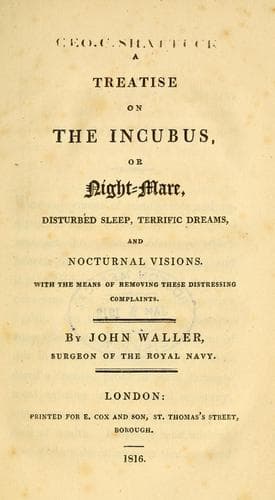
A Treatise on the Incubus, or Night-Mare, Disturbed Sleep, Terrific Dreams and Nocturnal Visions — John Shaqi
A Treatise on the Incubus, or Night-Mare, Disturbed Sleep, Terrific Dreams and Nocturnal VisionsWaller, John Augustine
HistoryChristian
A Treatise on the Incubus, or Night-Mare, Disturbed Sleep, Terrific Dreams and Nocturnal Visions
Waller, John Augustine
Nightmares; Sleep disorders
is quickly communicated to the whole system, and probably is the
principal cause of the final solution of the paroxysm. How this solution
is at length effected is, I confess, a difficult and obscure question.
There are two ways in which it takes place; the first and most frequent is
by the patient becoming perfectly awake, by which means he recovers at
once the power of volition, and the partial paralysis of the diaphragm and
thoracic muscles at the same moment ceases, these muscles being then moved
by the power of the will. The other mode by which a solution of the
paroxysm is effected, is by the patient falling into a more perfect sleep,
and losing that consciousness which accompanies Night-Mare. The
involuntary actions then go on as before without interruption, and if the
dreams continue, they are no longer of that harassing and distressing
kind, but are now natural and easy. It is not only in slight cases of
Incubus that the patient recovers from the disease without waking, but
sometimes I have known it to happen even in very severe paroxysms, where
I have become conscious of the place and situation in which I was, and yet
have instantly been asleep on the cessation of the paroxysm. There appears
to me a greater difficulty in explaining this mode of the solution of the
paroxysm than the other, as there seems no evident cause for the cessation
of the paralysis of the Diaphragm, &c. Every thing connected with the
phenomena of sleep, is extremely obscure; and nothing on this subject
appears to me more extraordinary, than the sudden transition from the
sleeping to the waking state. Whatever it is which takes place at that
moment in the brain, and in the whole system, takes place only partially
during Night-Mare. Is it very absurd to suppose that a part of the system
may recover the waking state, while the brain, or some other part, remains
asleep, for want of a sufficient stimulus to rouse them? I cannot help
thinking but something very similar to this takes place in Night-Mare:
hence the power of moving the lower extremities, whilst the superior ones
remain paralyzed: hence the little good resulting to the patient from his
own struggling, whilst a comparatively slight touch from another person is
sufficient to dispel the charm. Hence the appearance of visions, whilst in
every respect the patient appears to himself to be perfectly awake. It
seems that the brain continues to present a succession of images to the
mind as in sleep, whilst at the same time, the body is become susceptible
of external impressions, and conscious of internal ones, such as those
arising from the derangement which has taken place in the functions of the
heart and lungs.
Public-domain text, read in full here on John Shaqi.
Reviews
Reviews
No reviews yet
Be the first to share your thoughts on this work.
Join the Discussion
Join the discussion
Sign in to leave a comment or review.
Sign InorCreate an account