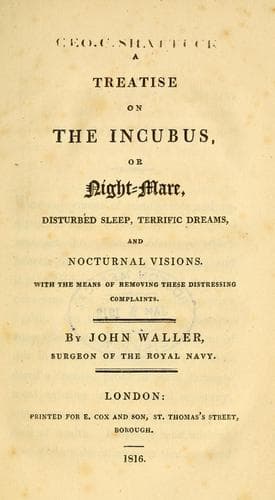
A Treatise on the Incubus, or Night-Mare, Disturbed Sleep, Terrific Dreams and Nocturnal VisionsWaller, John Augustine
HistoryChristian
A Treatise on the Incubus, or Night-Mare, Disturbed Sleep, Terrific Dreams and Nocturnal Visions
Waller, John Augustine
Nightmares; Sleep disorders
of repose, and have suffered more from its repeated attacks than any other
person I have ever met with, I hope to be able to throw some light on the
nature of this affection, and to point out some mode of relief to the
unfortunate victims of it.
The late Dr. Darwin, who had an admirable talent for explaining the
phenomena of animal life in general, is of opinion, that this affection is
nothing more than sleeping too sound; in which situation of things the
power of volition, or command over the muscles of voluntary motion, is too
completely suspended; and that the efforts of the patient to recover this
power, constitute the disease we call Night-Mare. In order to reconcile
this hypothesis with the real state of things, he is obliged to have
recourse to a method not unusual amongst theoretic philosophers, both in
medicine and other sciences--that is, when the hypothesis does not exactly
apply to the phenomenon to be explained by it, to twist the phenomenon
itself into such a shape as will make it fit, rather than give up a
favourite hypothesis. Now, in order to mould the Night-Mare into the
proper form, to make this hypothesis apply to it, he asserts, first, that
it only attacks persons when very sound asleep; and secondly, that there
cannot exist any difficulty of breathing, since the mere suspension of
volition will not produce any, the respiration going on as well asleep as
awake; so that he thinks there must needs be some error in this part of
the account. Any person, however, that has experienced a paroxysm of
Night-Mare, will be disposed rather to give up Dr. Darwin’s hypothesis
than to mistrust his own feelings as to the difficulty of breathing, which
is far the most terrific and painful of any of the symptoms. The dread of
suffocation, arising from the inability of inflating the lungs, is so
great, that the person, who for the first time in his life is attacked by
this “worst phantom of the night,” generally imagines that he has very
narrowly escaped death, and that a few seconds more of the complaint would
have inevitably proved fatal. This disease, although neglected by modern
physicians, was well described and understood by those of the seventeenth
century, as well as by the Greeks and Romans.[1] There are few affections
more universally felt by all classes of society, yet it is seldom at
present considered of sufficient consequence to require medical advice. To
those nevertheless who, from sedentary habits, and depraved digestion, are
the most frequent subjects of it, it is a source of great anxiety and
misery, breaking in upon their repose, and filling the mind with constant
alarms for more serious consequences, “making night hideous,” and
rendering the couch, which is to others the sweet refuge from all the
cares of life, to them an object of dread and terror. To such persons, any
alleviation of their sufferings will be considered an act of philanthropy;
as they are now in general only deterred from applying to the
Public-domain text, read in full here on John Shaqi.
Reviews
Reviews
No reviews yet
Be the first to share your thoughts on this work.
Join the Discussion
Join the discussion
Sign in to leave a comment or review.
Sign InorCreate an account