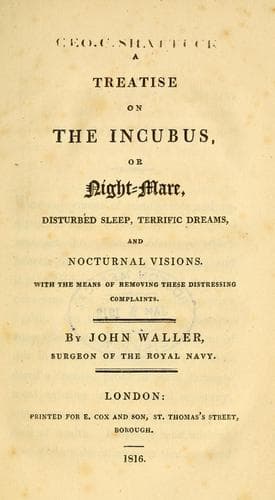
A Treatise on the Incubus, or Night-Mare, Disturbed Sleep, Terrific Dreams and Nocturnal Visions — John Shaqi
A Treatise on the Incubus, or Night-Mare, Disturbed Sleep, Terrific Dreams and Nocturnal VisionsWaller, John Augustine
HistoryChristian
A Treatise on the Incubus, or Night-Mare, Disturbed Sleep, Terrific Dreams and Nocturnal Visions
Waller, John Augustine
Nightmares; Sleep disorders
practitioners of medicine for relief, from the idea that their case is out
of the reach of medicine.
It is a very well known fact, however, that this affection is by no means
free from danger. I have known one instance in which a paroxysm of it
certainly proved fatal, and I have heard of several others. I do not doubt
indeed but that this happens oftener than is suspected, where persons have
been found dead in their beds, who had retired to rest in apparent health.
I do not know that any late writer has observed a fatal case of
Night-Mare, but we find a circumstance recorded by Cœlius Aurelianus, who
is supposed to have lived a short time before Galen, which, if true, is
very remarkable; and I know no reason why it should be doubted. Yet I am
aware that in the age in which we live, it is a common practice, not
merely to doubt, but to contradict every fact recorded by ancient writers,
which, if admitted, would militate against any received theory. Cœlius
Aurelianus, however, informs us, upon the authority of _Silimachus_, a
follower of Hippocrates, that this affection was once epidemic at Rome,
and that a great number of persons in that city died of it.[2]
A young man, of sober habits, about thirty years of age, by trade a
carpenter, had been all his life subject to severe attacks of Night-Mare.
During the paroxysm he frequently struggled violently, and vociferated
loudly. Being at Norwich for some business, which detained him there
several weeks, he one night retired to bed in apparent good health;
whether he had eaten supper, or what he had taken previously to going to
bed, or during the day, I cannot now remember. In the night, or towards
morning, he was heard by some of the family in the house where he lodged
to vociferate and groan as he had been accustomed to do during the
paroxysms of Night-Mare; but as he was, after no great length of time,
perfectly quiet, no person went to his assistance. In the morning,
however, it was soon observed that he did not, as usual, make his
appearance, and on some person going into his room, he was found dead,
having thrown himself by his exertions and struggles out of bed, with his
feet, however, still entangled among the bed-clothes. This patient, and
the circumstances attending his death, were very well known to me, and I
have not the least doubt that it was Night-Mare which proved fatal to him.
A similar case has been related to me by a person deserving of credit,
and I do not doubt but they are of more frequent occurrence than is
generally supposed. It may appear surprising to some, that a person should
struggle with so much violence as to throw himself out of bed, and yet not
shake off the Night-Mare, since, in general, it is sufficient to call a
person by his name, and he will recover. This is indeed true in common
cases, and in every case it is of much more service than any exertions
which the patient himself can make. I once at sea, in a paroxysm of
Public-domain text, read in full here on John Shaqi.
Reviews
Reviews
No reviews yet
Be the first to share your thoughts on this work.
Join the Discussion
Join the discussion
Sign in to leave a comment or review.
Sign InorCreate an account