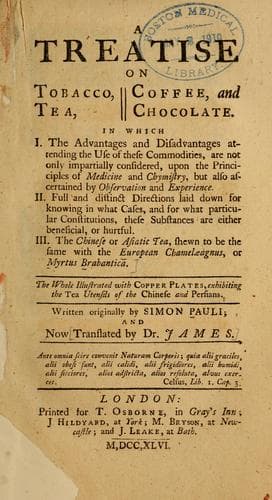
A Treatise on Tobacco, Tea, Coffee, and ChocolatePaulli, Simon
History
A Treatise on Tobacco, Tea, Coffee, and Chocolate
Paulli, Simon
Chocolate -- Early works to 1800; Coffee -- Early works to 1800; Tea -- Early works to 1800; Tobacco -- Early works to 1800
the Reason of thy supercilious Air: Do thou, in the mean time, guard
against a supercilious Behaviour, as much as thou possibly canst;
but, like a faithful Centinel, placed in a particular Post by thy
Master, rigidly maintain and adhere to those Things which, to thee,
appear best and most praise-worthy; and, for thy Comfort, remember
this, that if thou resolutely keepest thy Post, thou wilt, at last,
become the Admiration of those who before derided thee: Whereas, if
thou shamefully quittest thy Station, and succumbest to the heedless
and unthinking Herd, thou wilt be doubly derided." But, as moral
Reflections may be thought impertinent on such Occasions, we shall
return to our Subject. _Dodonæus_, therefore, in _Pemptad. 1. Lib. 2.
Cap. 20._ tells us, "that _Betony_ has oblong, broad, and green Leaves,
somewhat rough, serrated about the Edges, and resembling those of the
Oak, though somewhat smaller." Now, _Tulpius_ informs us, that the
Leaves of _Tea_ are oblong, acuminated and serrated about the Edges:
And _Olearius_ affirms, that they are about an Inch in Length, and
half an Inch in Breadth. _Tulpius_ also asserts, that in _China_, they
are of a dark green Colour; whereas, in _Japan_, they are of a fainter
Colour; so that these Descriptions quadrate very exactly with _Betony_.
The _Chamelæagnus_ is, by _Dodonæus_, in _Stirp. Histor. Pemptad. 6.
Cap. 20._ described in the following Manner: "The _Chamelæagnus_ is a
small and low Shrub, rarely rising to the Height of a Cubit: It sends
forth some Branches, which bear small, broad, and oblong Leaves, not
unlike those of the _Myrtle_, but harder, and frequently longer: All
the Parts of the Shrub, and especially its Seeds, are somewhat odorous:
It delights in wild and uncultivated Soils, which are somewhat marshy
and aqueous." The Authors before quoted, have made no Mention, either
of the Seeds, or Flowers; nor, though I have had an Opportunity of
turning over large Quantities of _Tea_, have I ever found any Part
of a Flower, Stem, Apex, Calyx, Down, Seed, Pods of Seed, Berries,
or any Thing analogous to any of these, except some few Pieces, of
a Kind of arundinacious Grass; from which we may justly infer, that
the _Chinese Tea_ delights in uncultivated, aqueous, and marshy
Soils, as well as the _European Chamelæagnus_; which, as described by
_Dodonæus_, exactly resembles the _Tea_ of the _Chinese_. The Reasons
why I have compared _Tea_ to _Betony_, are sufficiently obvious; since
my Accounts of the former, taken from _Trigautius_, _Rhodius_, and
_Bontius_, exactly agree to the latter; for _Trigautius_ affirms,
that the Leaves called _Tea_, when gathered from a certain Shrub, and
boiled in Water, afford that celebrated Liquor, so much used by the
_Chinese_, _Japonese_, and their neighbouring Nations: And _Rhodius_
asserts, that the Leaves of _Tea_ are, in a great measure, like those
of the _Myrtle_, and, in Bulk, equal to those of the _Pomegranate_. I
Public-domain text, read in full here on John Shaqi.
Reviews
Reviews
No reviews yet
Be the first to share your thoughts on this work.
Join the Discussion
Join the discussion
Sign in to leave a comment or review.
Sign InorCreate an account