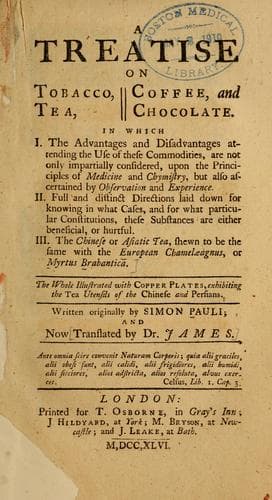
A Treatise on Tobacco, Tea, Coffee, and ChocolatePaulli, Simon
History
A Treatise on Tobacco, Tea, Coffee, and Chocolate
Paulli, Simon
Chocolate -- Early works to 1800; Coffee -- Early works to 1800; Tea -- Early works to 1800; Tobacco -- Early works to 1800
have, in a particular Manner, mentioned the Crenations of the Leaves,
because no such Circumstance is specified, either by _Dodonæus_,
in his Description of the _Chamelæagnus_, or by _Trigautius_ and
_Rhodius_, in their Accounts of the Leaves of _Tea_, which, according
to _Olearius_, are about an Inch long, half an Inch broad, and, when
dried, assume a blackish Colour, all which Circumstances hold true of
the _Chamelæagnus_. _Tulpius_ informs us, that the Leaves of _Tea_
are of a dark green Colour, oblong, acuminated, and crenated about
the Edges; and _Bontius_ describes them with small Incisions about
the Edges, like those of the _Daisy_: Besides, if the Reader compares
what _Dodonæus_ advances, with respect to the native Soil of the
_Chamelæagnus_, with the Description I have given of it, he will find
it probable that it is also produced in _Tartary_; so that we have
just Reason to conclude, that the _Cha_ of the _Tartars_, and _Thee_
of the _Chinese_, are nothing else but the _European Chamelæagnus_.
Another Analogy is also to be observed between the Leaves of _Tea_, and
those of the _Chamelæagnus_, which is, that only the larger Leaves of
each of them are crenated. If it should be objected, that _Dodonæus_
inclined to insinuate, that the Leaves of the _Chamelæagnus_ are
like those of the _Myrtle_; and that the Leaves of the true _Myrtle_
are not crenated: I answer, that I am sufficiently apprised of this;
but, at the same time, would have the Objector remember, that _Caspar
Bauhine_ finds some Things wanting in the Figure of the _Chamelæagnus_,
exhibited in the _Latin_ Edition of _Dodonæus_, and for that Reason,
prefers the Figure in the _Dutch_ Edition to it. His Description is
also very defective, since he neither mentions the Crenation of the
Leaves, nor the Sporting of Nature, which are very material Points;
since the Leaves are not all crenated in the same Manner, and sometimes
not crenated at all, especially at the Points, till they have arrived
at a certain Age and Bulk. Similar Sportings of Nature are frequently
to be observed; since, in one and the same Mallow, it often happens,
that one Leaf is not like another. There is also a surprizing Variety,
both in the Form and Number of the Leaves of the _Eupatorium Canadense
Foliis Enulæ Jacobi Cornuti_ of the _Lysimachia Lutea Major_ and
_Minor_, and of the _Pseudolysimachia_. It is also sufficiently known,
that the _Peruvian_ Flower in _Europe_, varies every Day considerably
from the same Flower in _Peru_; but we are not, for this Reason,
to deny that they both belong to the same Species. Thus, though in
_Europe_, there is a Kind of Sporting of Nature in the Leaves of the
_Chamelæagnus_; yet all these Leaves, when most accurately compared
with the _Tartarian_ or _Chinese Tea_, are only found to differ
inconsiderably from them in Size, Colour, and Crenations: So that
we may conclude, that the Shrub _Chamelæagnus_ belongs to the same
Public-domain text, read in full here on John Shaqi.
Reviews
Reviews
No reviews yet
Be the first to share your thoughts on this work.
Join the Discussion
Join the discussion
Sign in to leave a comment or review.
Sign InorCreate an account