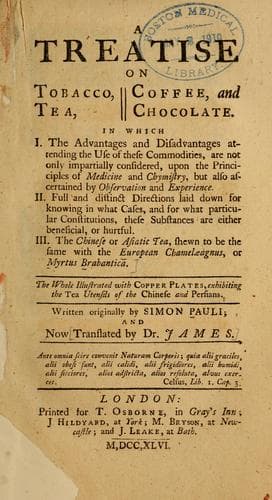
A Treatise on Tobacco, Tea, Coffee, and ChocolatePaulli, Simon
History
A Treatise on Tobacco, Tea, Coffee, and Chocolate
Paulli, Simon
Chocolate -- Early works to 1800; Coffee -- Early works to 1800; Tea -- Early works to 1800; Tobacco -- Early works to 1800
or modern Botanists; yet that it is possessed of singular Virtues,
is evinced from this, that _Pliny_, in _Lib. 24. Cap. 11._ informs
us, that the Herb called _Rhus_, which, according to _Clusius_ and
_Dodonæus_, is our _Chamelæagnus_, expels Poison, and cures scalled
Heads; a signal Proof, that whether green, or dry, it abounds with a
singular volatile Salt and Sulphur; which is also farther confirmed,
partly by its acrid, tho' not ungrateful Smell, and partly by the
Effects it produces. This is sufficiently confirmed by the Authority of
_Dodonæus_, who speaks of its Qualities and Virtues in the following
Manner: "Its Seeds, _says he_, are intensely hot and dry, almost in
the third Degree: Its Leaves are also hot and dry, though in a much
smaller Degree: Its Fruit, which is prejudicial to the Brain, when
used in preparing Ale, which is customary with many, renders the Ale
highly offensive to the Head, and soon productive of Intoxication or
Drunkenness. The whole Shrub, and its Fruit, when dried, and laid among
Clothes, preserve them from Moths and Worms." It also banishes Dormice,
as I have observed in my _Quadripartit. Botan._ Besides, a certain
Person of great Distinction in _Holstein_, and a Man of the strictest
Veracity, informs me, that the _Polanders_ use our _Chamelæagnus_ for
killing the Lice of their Hogs; for, if this Plant is strewed under
them in their Styes, the Lice which infest them will be destroyed in
a few Hours; nor will their Nits ever become alive. Besides, Serpents
are never found to have their Holes in those Forests, which produce the
_Chamelæagnus_, nor are they ever observed to come near it, much less
to creep through it, as I have been informed by Forest-Keepers of great
Veracity. It is not, therefore, to be denied, but the _Chamelæagnus_
is an Herb of singular and excellent Virtues, since it produces these,
and a great many other uncommon Effects. _Dalechampius_, Author of
the _Herbarum Lugdunense_, in _Cap. 1._ gives us the following Account
of it: "The _Rhus Sylvestris Dodonæi_, and the _Rhus Plinii_ seems
to be another Plant, which is by some called the _Myrtus_, by others
the _Pseudomyrsine_, and the _Myrtus Brabantica_. It is a low, woody,
hard Plant, with many Branches, which bear pretty long Leaves, not
unlike those of the _Box-Tree_. Between the Branches rise many Twigs,
bearing, as it were, a great Number of Ears, which are, at first,
loaded with many small Flowers, and afterwards with a Congeries of many
angular Seeds, full of a certain pingueous Humour, of the same bitter
Taste with the Leaves, Flowers, and Fruit, but of a pleasant grateful
Smell. The Inhabitants of _Roan_ in _Normandy_, whose dark and gloomy
Forests produce great Quantities of it, call it _Piment Royale_, as it
were _Melyssophyllum Regium_. The Country People in _Summer_ gather
the Branches loaded with the Leaves and Seeds, tie them up in small
Bundles, for no other Purpose, but to give Clothes an agreeable Scent,
Public-domain text, read in full here on John Shaqi.
Reviews
Reviews
No reviews yet
Be the first to share your thoughts on this work.
Join the Discussion
Join the discussion
Sign in to leave a comment or review.
Sign InorCreate an account