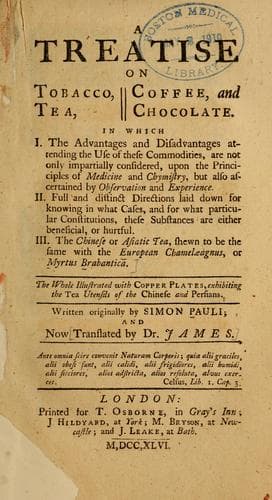
A Treatise on Tobacco, Tea, Coffee, and ChocolatePaulli, Simon
History
A Treatise on Tobacco, Tea, Coffee, and Chocolate
Paulli, Simon
Chocolate -- Early works to 1800; Coffee -- Early works to 1800; Tea -- Early works to 1800; Tobacco -- Early works to 1800
and hinder them from being corroded by Worms and Moths. Its highly
bitter Taste evinces that it is remarkably drying and discutient, and
that it is in a peculiar Manner adapted to kill and expel Worms,
whether exhibited internally, or applied externally: It flowers in the
Months of _May_ and _June_, and bears Fruit in _July_ and _August_."
An anonymous Author, who makes some Additions to _Dodonæus_, speaks
of it in the following Manner: "The _Gagel_ has, in _English_, the
Appellation of Gold from the Gold-coloured Flowers, or the clammy
sulphureous Matter lodged between the Seeds and their Husks. _Gagel_
is, by some, esteemed a good Remedy, in all Cases, wherein the true
_Myrtus_ is used; but this Opinion is false: The Flowers and the clammy
sulphureous Substance lodged between the Seeds, and their Husks, are,
by some, accounted good in Consumptions and all other Disorders of the
Breast. These are also used in making Gold; others use the whole Plant
as an Antidote against Poison. Some put _Gagel_ into Beer instead of
Hops; whilst others put it into Must, affirming, that it gives the Wine
an agreeable Flavour, without injuring the Brain." These last Words
excellently describe those Virtues of the _Chamelæagnus_, in which it
agrees with the _Chinese Tea_, especially as the Author had before
informed us, that, in consequence of its abounding with a viscid,
yellowish Dew, or roscid Sulphur, it was of a drying Quality, and
that it has hitherto been despised, as an Herb possessed of no other
Virtues, than that of intoxicating, when Ale is prepared with it; and
certainly, this Effect is to be ascribed to no other Cause, than the
large Quantity of Sulphur contained in the _Chamelæagnus_: But I am
sensible, that I am entering upon chymical Principles, which I have
fully explained in another Work, when treating of malignant Fevers,
and especially the Nature, Genius, and Effects of volatile Salts and
Sulphurs. Now, as no one has hitherto contradicted any of my Opinions,
I hope this seeming Paradox, with respect to _Tea_, will meet with
the like favourable Reception; for, from the Comparison instituted
between the _Chinese Tea_, and the true _Myrtle_, it is evident, that
they agree, not only in Form, but also in Virtues and Faculties: And
as, not only _Tea_, but also the _Chamelæagnus_, is like the true
_Myrtle_, and may be used as a Succedaneum to it, we cannot doubt, but
the _Chamelæagnus_ is the genuine _Cha_ of the _Tartars_, or _Thee_ of
the _Chinese_; and as I have sufficiently demonstrated this, I hope
the _Europeans_ will not, for the future, be so foolish, as to despise
the _Tea_ produced in their own Climate, in comparison of that which
is brought from _China_: Besides, that _Tea_ is nothing else but our
_Chamelæagnus_, may be proved by the following Syllogism.
Whatever Things agree in Form and Virtues, are of the same Species:
The _Cha_ of the _Tartars_, the _Thee_ of the _Chinese_, and our
_Chamelæagnus_, agree in Form and Virtues:
Public-domain text, read in full here on John Shaqi.
Reviews
Reviews
No reviews yet
Be the first to share your thoughts on this work.
Join the Discussion
Join the discussion
Sign in to leave a comment or review.
Sign InorCreate an account