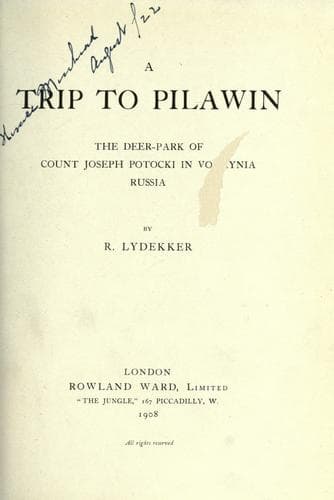
A Trip to Pilawin, the Deer-park of Count Joseph Potocki in Volhynia, Russia — John Shaqi
A Trip to Pilawin, the Deer-park of Count Joseph Potocki in Volhynia, RussiaLydekker, Richard
History
A Trip to Pilawin, the Deer-park of Count Joseph Potocki in Volhynia, Russia
Lydekker, Richard
Game reserves; Pilawin (Volhynia, Ukraine)
The forest consists mainly of Scotch fir, oak (of two kinds), birch,
and aspen. Generally the pines and deciduous trees grow upon different
tracts, while even the oak, birch, and aspen severally display a
marked tendency to occupy separate areas of their own. In some cases,
however, the forest assumes a more or less completely mixed character.
It is this varied type of forest, intercalated with open clearings
and stretches of marsh and lake, that renders the enclosed area so
admirably adapted for the home of deer of various kinds collected from
many parts of Northern Europe and Asia, and whose habits consequently
display considerable diversity.
Many of the firs in the forest are of gigantic dimensions, one in
particular measuring no less than twelve feet in girth at a man’s
height from the ground.
One peculiarity of the Pilawin forest--shared by no other in the
district--is the presence of numerous luxuriant patches of the Crimean
azalea (_Azalea pontica_), a species whose nearest natural habitat
is the Crimea. According to local tradition, it was introduced from
there to Pilawin by Tatars about two centuries ago; the seed having
been conveyed in the nose-bags of their horses. The yellow blossoms
of this fine azalea impart an unwonted brilliance to large patches of
the Pilawin forest in spring. At the time of my visit there was an
abundance of edible berries of the cranberry and bilberry type.
As Pilawin has only been enclosed for about four years, it may be
regarded as still in the experimental stage; but so far as it has at
present gone, the experiment promises to be a distinct success.
[Illustration: WAPITI IN AUTUMN.]
As the climate in winter is extremely severe, it is obvious that only
hardy species can be expected to thrive; and it is the main object of
the owner that the representatives of these should appear as if they
were living in a really wild state. To what extent he has succeeded
in this, will be apparent in the sequel. When the Pilawin park was
first enclosed, the only large game in the forest were roedeer, of
which a certain number were included within the ring-fence. These have
now increased and multiplied to such an extent that roebuck-shooting is
permitted in Pilawin; and, indeed, is almost necessary in order to keep
the number of these deer within proper limits. In connection with these
roebuck it may be mentioned that during the unusually severe winter of
1906-1907 a considerable number of them succumbed to the effects of the
cold, whereas not a single death occurred among the introduced species.
With the exception of the wild boars referred to above as inhabiting
the pine-forests near Schepetowka, roebuck are the only big game now
to be met with in the district immediately around Pilawin. Elk occur,
however, in the forests about forty miles to the northwards, and an
occasional straggler from these may make its appearance near the
preserve in spring.
[Illustration: WOLF KILLED NEAR ANTONINY IN 1907.]
Public-domain text, read in full here on John Shaqi.
Reviews
Reviews
No reviews yet
Be the first to share your thoughts on this work.
Join the Discussion
Join the discussion
Sign in to leave a comment or review.
Sign InorCreate an account