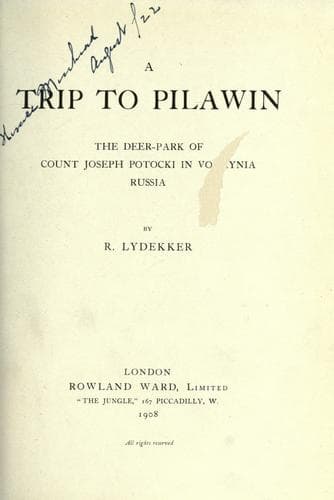
A Trip to Pilawin, the Deer-park of Count Joseph Potocki in Volhynia, RussiaLydekker, Richard
History
A Trip to Pilawin, the Deer-park of Count Joseph Potocki in Volhynia, Russia
Lydekker, Richard
Game reserves; Pilawin (Volhynia, Ukraine)
Wolves, too, either singly or in small parties, may be in evidence
during winter; but lynxes were exterminated many years ago; while
bears, as already mentioned, have been unknown for at least a century
and a half; and red deer, to say nothing of bison, disappeared at
a much earlier date. The last beaver known to inhabit the Pilawin
district was killed in 1904; but these rodents are still not uncommon
some fifty miles to the northward, and subsequently to our visit (in
December) the species was reintroduced into the preserve, where a
portion of one of the lakes has been enclosed for its reception. Two
specimens--a young and an old male--were trapped about fifty miles
north of the park; and on arrival the old one was turned out in the
enclosure, where it proceeded to make itself at home, constructing a
lodge and gnawing timber. Some time later the young one was introduced,
but the old one chased it away, and eventually bit and drowned the
unfortunate creature. Badgers are still numerous in certain parts of
Pilawin, where they have some huge “earths,” while a few otters remain,
and martens and polecats abound.
[Illustration: THE PILAWIN BEAVER.]
A few hares are to be met with in the open country; but rabbits are
unknown in the district, the ground being for the most part too moist
and low-lying to suit their habits, although they occur some miles away.
As regards birds, a flock of some thirty bustards (_Otis tarda_) was
reported not far from Antoniny about the time of our arrival; and the
species is still fairly common in this part of Volhynia. Cranes and
white storks are common in summer, but both species were on the eve of
departure at the time of our visit. In some of the villages situated
near swamps, almost every house has at least one stork’s nest on its
roof; the total number of nests in a colony of this sort ranging from
fifty to one hundred. Although the species is protected in Sclavonia,
in this country there is nothing to prevent any one from shooting
a stork. The bird is, however, considered to be semi-sacred by the
natives; the popular belief being that if a stork is shot, its mate
will come and set fire to the house of the destroyer.
Black storks are very scarce, and the appearance of one during our
visit was therefore an unusual event. They depart later than the white
species.
[Illustration: ELK IN WINTER.]
Public-domain text, read in full here on John Shaqi.
Reviews
Reviews
No reviews yet
Be the first to share your thoughts on this work.
Join the Discussion
Join the discussion
Sign in to leave a comment or review.
Sign InorCreate an account