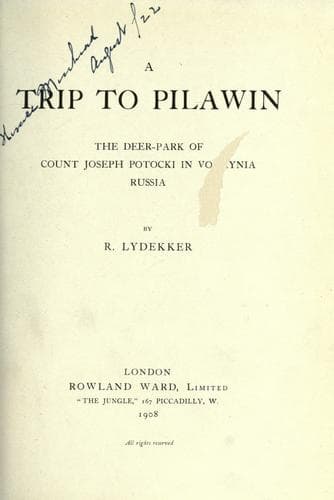
A Trip to Pilawin, the Deer-park of Count Joseph Potocki in Volhynia, RussiaLydekker, Richard
History
A Trip to Pilawin, the Deer-park of Count Joseph Potocki in Volhynia, Russia
Lydekker, Richard
Game reserves; Pilawin (Volhynia, Ukraine)
This highly satisfactory state of affairs may doubtless be attributed
to the absolutely natural conditions in which the elk are living,
and the practically unlimited area over which they can wander. The
existence here and there of large natural and artificial lakes (the
latter formed by damming up small streams), coupled with the numerous
swampy tracts, makes the forest an ideal one for these animals, and it
is evident that they thoroughly appreciate their surroundings. One of
the prettiest scenes witnessed during our visit was the sight of a cow
elk leading her two calves across the largest and deepest lake with the
apparent intention of accustoming them to swim. One of the yearling
bull elks (not born on the estate) was in the habit of coming in the
evenings close up to the shooting-lodge in order to be fed with bread;
and if its wants were not promptly attended to, would actually put
its head in at the open door or window. Close examination of this elk
served to convince me more than ever that the glandular tuft on the
inner side of the hock corresponds with the similarly placed callosity
or “wart” in the horse, and consequently that the latter represents
a decadent gland. I also noticed on the forehead, a short distance
above the budding antlers, a pair of whorls in the hair, which are not
generally mentioned in descriptions of the species, and may likewise be
glandular in function.
The length of limb distinctive of elk generally is especially
noticeable in immature animals. Compared with other deer, elk at this
age may indeed be likened to storks among birds; the length of limb
being for the same purpose in both.
That elk and other large species of wild deer require a very extensive
area in order not to deteriorate seems to be undoubted. The owner of
Pilawin considers, indeed, that the number of head of these animals
should be limited to one to every ten acres; while he is also of
opinion that the maximum number of true deer in the preserve should not
exceed three hundred head, and that the elk herd should be limited to
one hundred.
In summer the main food-supply of the Pilawin elk apparently consists
of the leaves of deciduous trees, especially aspen; but in winter
this is replaced by the young shoots and twigs of birch, to obtain
which the elk are constantly breaking down young saplings. The natural
food-supply of the preserve is, however, largely augmented by patches
of oats, buckwheat, lupin, potatoes, and Jerusalem artichokes, which
are sown or planted in the clearings of the forest wherever the soil is
suitable. The buckwheat and oats form summer fodder, while the lupin,
potatoes, artichokes, acorns, and horse-chestnuts serve as a winter
supply, the deer soon learning to scrape out the tubers from the
ground with their hoofs.
[Illustration: WAPITI IN WINTER.]
Public-domain text, read in full here on John Shaqi.
Reviews
Reviews
No reviews yet
Be the first to share your thoughts on this work.
Join the Discussion
Join the discussion
Sign in to leave a comment or review.
Sign InorCreate an account