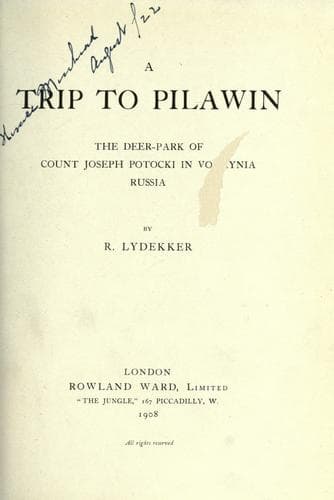
A Trip to Pilawin, the Deer-park of Count Joseph Potocki in Volhynia, Russia — John Shaqi
A Trip to Pilawin, the Deer-park of Count Joseph Potocki in Volhynia, RussiaLydekker, Richard
History
A Trip to Pilawin, the Deer-park of Count Joseph Potocki in Volhynia, Russia
Lydekker, Richard
Game reserves; Pilawin (Volhynia, Ukraine)
Before leaving the subject of elk, reference may be made to a point in
connection with the conformation of their antlers which struck me as
the result of an examination of a large series of immature specimens in
the Pilawin shooting-lodge.
It has long been recognised that the antlers of elk belong to what is
known as the forked type, which occurs typically in such species as
the roebuck, Père David’s deer, and the American white-tailed and mule
deer. In this type, it may be well to remind the reader, there is no
brow or bez tine, and the main beam of the antler divides at a longer
or shorter distance above the burr into a single fork, of which the
back-prong nearly always divides again, while in many cases both prongs
are more or less divided, the greatest complexity occurring, however,
very frequently in the hind one.
Hitherto elk-antlers have been regarded as altogether _sui
generis_--mainly on account of the fact that they rise at right
angles to the middle line of the skull. But a comparison of immature
specimens in which the front prong of the main fork is double with
adult antlers of the mule-deer will show that the two are practically
identical in type. In both forms the front prong of the main fork is
two-tined, while the hind prong carries three tines. The distinction
between the two is, in fact, chiefly restricted to the difference in
their orientation. In the case of those adult elk in which the antlers
assume the characteristic shovel-like form, the resemblance becomes, of
course, more or less completely lost.
If this view be correct, it will be advisable to modify the
classification of the _Cervidae_ adopted in _Deer of All Lands_, and to
place the elk in the neighbourhood of the roebuck and the mule-deer,
with which it agrees in the structure of the foot-skeleton. Moreover,
it seems not improbable that the antlers of reindeer are really of the
forked (in contradistinction to the brow-tined) type, and if this be
so, that genus must also be placed near the roebuck--an arrangement
which would accord with the one proposed many years ago by the late Sir
Victor Brooke on the evidence afforded by the structure of the skeleton
of the forelimb.
The present opportunity may likewise be taken of referring to two
very fine pairs of elk-antlers obtained by Mr. Sokalski in Siberia.
Despite the fact of their being palmated, these antlers (which I hope
to have the opportunity of describing on a future occasion) may serve
to confirm the distinctness of the East Siberian elk (_Alces machlis
bedfordiae_), as they appear to differ in certain details of form from
those of European elk.
Returning to the Pilawin deer, the next to be noticed are the American
wapiti, which are flourishing fully as well as the elk; the number of
fawns born during the year being nine.
Public-domain text, read in full here on John Shaqi.
Reviews
Reviews
No reviews yet
Be the first to share your thoughts on this work.
Join the Discussion
Join the discussion
Sign in to leave a comment or review.
Sign InorCreate an account