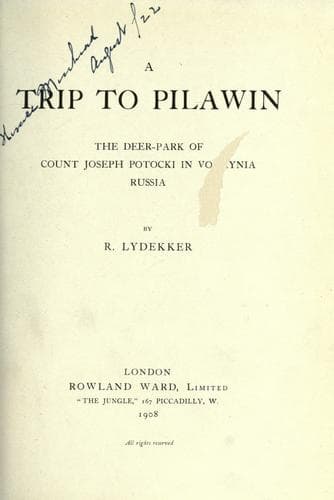
A Trip to Pilawin, the Deer-park of Count Joseph Potocki in Volhynia, RussiaLydekker, Richard
History
A Trip to Pilawin, the Deer-park of Count Joseph Potocki in Volhynia, Russia
Lydekker, Richard
Game reserves; Pilawin (Volhynia, Ukraine)
Our attention was first attracted by the magnificent new Greek
church, built of white bricks, with its golden cupola and lofty,
detached campanile. The church faces the “Bristol,” and behind it
are the beautiful public gardens, which claimed a full share of our
admiration. We also visited several of the fine old Catholic churches,
including the famous cathedral. The striking and lofty monument to the
Polish King Sigismund, as well as the fine statue of the astronomer
Copernicus, were likewise inspected and admired. Perhaps, however,
the portion of the city which chiefly impressed us was the fine old
market-place, with its irregular, picturesque buildings, its numerous
stalls, and the people of diverse nationalities by whom it was
thronged, all busy in either buying or selling.
[Illustration: THE BIG LAKE IN PILAWIN.]
By good luck, we also enjoyed the opportunity of seeing one of the
Czar’s Tcherkess cavalry regiments marching through the city; the sable
uniforms and tall black astrachan papakhas (busbies) of the troopers
forming a striking contrast to the white jackets of the Cossacks, who
are to be seen everywhere in the streets.
[Illustration: EUROPEAN BISON IN THE OPEN.]
After returning to our hotel, by 3.30 P.M. we were on our way to
Terespol station, the terminus of the Kieff line, which we had to leave
for Schepetowka, our destination, at five o’clock. We were somewhat
delayed on our way by a great crush of vehicles at the bridge over the
Vistula; and owing to the crowd of passengers at the station itself,
taking tickets and registering the baggage was no easy matter; but it
was eventually accomplished (by the hotel porter), and we were soon
comfortably established in a sleeping compartment of the train ready
for the start.
Here a word may be said in commendation of the railway service in
this part of the Russian Empire; that is to say, when you are once in
the train. The first-class sleeping compartments are comfortable and
convenient; the _cuisine_ is excellent; and the attendants are civil,
attentive, and expert at interpreting the wants of those passengers to
whom Russian and Polish are unknown tongues. Punctuality is, however, a
virtue which on some occasions might be more cultivated.
At 5.10 A.M. on Thursday (only ten minutes behind our scheduled time)
we reached Schepetowka station, where we found an open carriage, drawn
by four horses abreast, in waiting; and in five minutes we were on our
way to Antoniny, the country seat of the Count and Countess Potocki.
Small strongly-built phaetons with varnished wood-work are used for
travelling. They are built at Vienna, and can be driven either with a
four-in-hand or four abreast. A four-horse team is always kept ready at
each changing-station. When travelling at night a smaller vehicle goes
in front with torches. For baggage a second carriage is provided.
[Illustration: THE MAIN ENTRANCE OF THE ANTONINY PALACE.]
Public-domain text, read in full here on John Shaqi.
Reviews
Reviews
No reviews yet
Be the first to share your thoughts on this work.
Join the Discussion
Join the discussion
Sign in to leave a comment or review.
Sign InorCreate an account