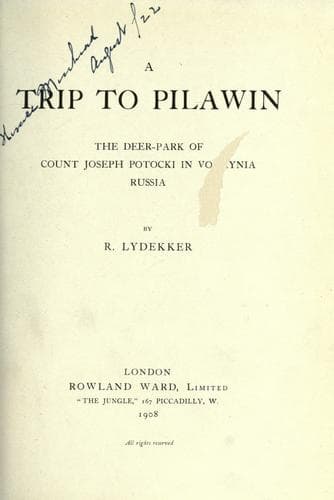
A Trip to Pilawin, the Deer-park of Count Joseph Potocki in Volhynia, Russia — John Shaqi
A Trip to Pilawin, the Deer-park of Count Joseph Potocki in Volhynia, RussiaLydekker, Richard
History
A Trip to Pilawin, the Deer-park of Count Joseph Potocki in Volhynia, Russia
Lydekker, Richard
Game reserves; Pilawin (Volhynia, Ukraine)
As there had been a deluge of rain during the night, the road, which
for the greater part of the way formed a mere track across the yielding
black alluvial soil, was very bad going, being in places indeed little
better than lakes of mud, and almost everywhere cut up into deep ruts.
Despite this (and the bad state of the track, as well as the condition
of several of the wooden bridges, would have well-nigh broken the heart
of an English coachman), with only a single change of horses, the
journey of some fifty kilometres was safely accomplished in a little
over four hours; and by half-past nine, that is to say, about sixty-one
hours from London, we were heartily welcomed by our kind host and
hostess and their family. It should be added that a metalled road is in
course of construction, which, when completed, will render the journey
from Schepetowka to Antoniny much easier.
To adequately describe Antoniny would far exceed the limits at my
disposal; while even if considerations of space were non-existent, it
would be difficult to do justice to a domain of such magnificence.
It must suffice, then, to state that the palace, which is admirably
situated on rising ground, and looks on to a spacious courtyard, with
the stables on the farther side, has been added to by successive owners
till it has attained what may be truly termed regal proportions, while
it is kept up in corresponding style and state; the owner flying his
own flag when in residence, while when the Countess alone is at home
her flag is substituted.
As an indication of the owner’s sporting tastes, reference may be
made to a fine series of trophies of African and Indian big game
displayed on portions of the walls of the hall as well as on those of
the galleries and corridors above. These trophies are the results of
four separate hunting trips undertaken by the Count: to India, Ceylon,
Somaliland, and the Blue Nile. The Somali and Ceylon trips have been
respectively described in a couple of handsome and lavishly illustrated
volumes, the former of which has been translated into English. Among
the trophies on which the owner sets especial store may be mentioned
the heads of a beisa oryx (_Oryx beisa_) and of a dibatag or Clarke’s
gazelle (_Ammodorcas clarkei_), the horns of the latter approaching
“record” measurements. Personally, however, I was more interested
in the skins of a Somali lion and lioness which show the abundant
brown-spotting of the limbs, underparts, and flanks, characteristic of
this race (_Felis leo somalica_). The lion skin, which (as is proved by
the skull) belonged to an adult animal, is further remarkable for the
practical absence of mane. Spotting seems peculiar (except in the case
of cubs) to East African lions, and attains its maximum development in
the Masai lion (_F. leo masaica_) of German East Africa.
Public-domain text, read in full here on John Shaqi.
Reviews
Reviews
No reviews yet
Be the first to share your thoughts on this work.
Join the Discussion
Join the discussion
Sign in to leave a comment or review.
Sign InorCreate an account