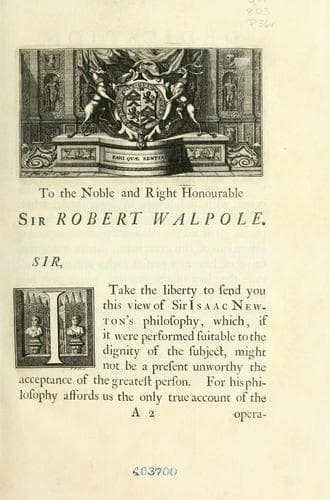
A View of Sir Isaac Newton's PhilosophyPemberton, Henry
Science
A View of Sir Isaac Newton's Philosophy
Pemberton, Henry
Newton, Isaac, 1642-1727. Principia
Chief Justice of the Common Pleas, of_
Ireland
Mr Joseph Wyeth
Thomas Wyndham, _Esq;_
_Rev._ Mr John Wynne
Y
Mr John Yardley, _Surg. in_ Coven.
Mr Thomas Yates
Mrs Yeo, _of_ Exeter, _Bookseller_
_Sir_ William Yonge
_Lady_ York
Nicholas Young, _of the_ Inner-Temple, _Esq;_
Hitch Young, _Esq;_
_Rev._ Edward Young, _L. L. D._
[Illustration]
INTRODUCTION.
THE manner, in which Sir ~ISAAC NEWTON~ has published his philosophical
discoveries, occasions them to lie very much concealed from all, who
have not made the mathematics particularly their study. He once,
indeed, intended to deliver, in a more familiar way, that part of
his inventions, which relates to the system of the world; but upon
farther consideration he altered his design. For as the nature of
those discoveries made it impossible to prove them upon any other than
geometrical principles; he apprehended, that those, who should not
fully perceive the force of his arguments, would hardly be prevailed
on to exchange their former sentiments for new opinions, so very
different from what were commonly received[1]. He therefore chose
rather to explain himself only to mathematical readers; and declined
the attempting to instruct such in any of his principles, who, by
not comprehending his method of reasoning, could not, at the first
appearance of his discoveries, have been persuaded of their truth. But
now, since Sir ~ISAAC NEWTON~’s doctrine has been fully established
by the unanimous approbation of all, who are qualified to understand
the same; it is without doubt to be wished, that the whole of his
improvements in philosophy might be universally known. For this purpose
therefore I drew up the following papers, to give a general notion
of our great philosopher’s inventions to such, as are not prepared
to read his own works, and yet might desire to be informed of the
progress, he has made in natural knowledge; not doubting but there were
many, besides those, whose turn of mind had led them into a course of
mathematical studies, that would take great pleasure in tasting of this
delightful fountain of science.
Public-domain text, read in full here on John Shaqi.
Reviews
Reviews
No reviews yet
Be the first to share your thoughts on this work.
Join the Discussion
Join the discussion
Sign in to leave a comment or review.
Sign InorCreate an account