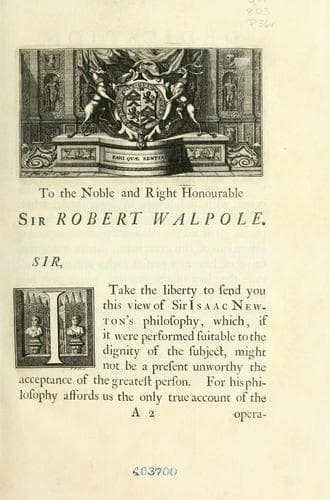
A View of Sir Isaac Newton's PhilosophyPemberton, Henry
Science
A View of Sir Isaac Newton's Philosophy
Pemberton, Henry
Newton, Isaac, 1642-1727. Principia
2. IT is a just remark, which has been made upon the human mind, that
nothing is more suitable to it, than the contemplation of truth; and
that all men are moved with a strong desire after knowledge; esteeming
it honourable to excel therein; and holding it, on the contrary,
disgraceful to mistake, err, or be in any way deceived. And this
sentiment is by nothing more fully illustrated, than by the inclination
of men to gain an acquaintance with the operations of nature; which
disposition to enquire after the causes of things is so general, that
all men of letters, I believe, find themselves influenced by it. Nor
is it difficult to assign a reason for this, if we consider only, that
our desire after knowledge is an effect of that taste for the sublime
and the beautiful in things, which chiefly constitutes the difference
between the human life, and the life of brutes. These inferior animals
partake with us of the pleasures, that immediately flow from the bodily
senses and appetites; but our minds are furnished with a superior
sense, by which we are capable of receiving various degrees of delight,
where the creatures below us perceive no difference. Hence arises
that pursuit of grace and elegance in our thoughts and actions, and
in all things belonging to us, which principally creates imployment
for the active mind of man. The thoughts of the human mind are too
extensive to be confined only to the providing and enjoying of what
is necessary for the support of our being. It is this taste, which
has given rise to poetry, oratory, and every branch of literature and
science. From hence we feel great pleasure in conceiving strongly, and
in apprehending clearly, even where the passions are not concerned.
Perspicuous reasoning appears not only beautiful; but, when set forth
in its full strength and dignity, it partakes of the sublime, and not
only pleases, but warms and elevates the soul. This is the source of
our strong desire of knowledge; and the same taste for the sublime
and the beautiful directs us to chuse particularly the productions of
nature for the subject of our contemplation: our creator having so
adapted our minds to the condition, wherein he has placed us, that all
his visible works, before we inquire into their make, strike us with
the most lively ideas of beauty and magnificence.
Public-domain text, read in full here on John Shaqi.
Reviews
Reviews
No reviews yet
Be the first to share your thoughts on this work.
Join the Discussion
Join the discussion
Sign in to leave a comment or review.
Sign InorCreate an account