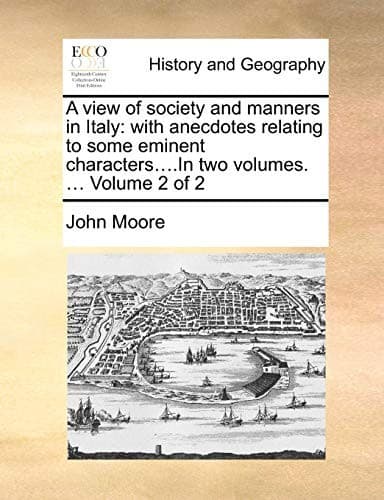
A View of Society and Manners in Italy, Volume 2 (of 2): With Anecdotes Relating to some Eminent Characters — John Shaqi
A View of Society and Manners in Italy, Volume 2 (of 2): With Anecdotes Relating to some Eminent CharactersMoore, John
History
A View of Society and Manners in Italy, Volume 2 (of 2): With Anecdotes Relating to some Eminent Characters
Moore, John
Italy -- Description and travel -- Early works to 1800; Italy -- Social life and customs -- Early works to 1800
However humane and reasonable this conduct may be thought
by many, there were people who condemned it as an injudicious piece of
lenity, which might have a tendency to sink the dignity of the sacred
office, and expose it to future insults. If such behaviour as this did
not pass without blame, it may be easily supposed, that few of the late
Pope’s actions escaped uncensured; and many who loved the easy amiable
dispositions of the man, were of opinion, that the spirit of the times
required a different character on the Papal throne. This idea prevailed
among the Cardinals at the late election, and the Conclave is supposed
to have fixed on Cardinal Braschi to be Pope, from the same motive that
the Roman senate sometimes chose a Dictator to restore and enforce the
ancient discipline.
LETTER XLVIII.
Rome.
Pius the Sixth performs all the religious functions of his office in
the most solemn manner; not only on public and extraordinary occasions,
but also in the most common acts of devotion. I happened lately to be
at St. Peter’s church, when there was scarcely any other body there;
while I lounged from chapel to chapel, looking at the sculpture and
paintings, the Pope entered with a very few attendants; when he came
to the statue of St. Peter, he was not satisfied with bowing, which is
the usual mark of respect shewn to that image; or with kneeling, which
is performed by more zealous persons; or with kissing the foot, which
I formerly imagined concluded the climax of devotion; he bowed, he
knelt, he kissed the foot, and then he rubbed his brow and his whole
head with every mark of humility, fervour, and adoration, upon the
sacred stump.—It is no more, one half of the foot having been long
since worn away by the lips of the pious; and if the example of his
Holiness is universally imitated, nothing but a miracle can prevent
the leg, thigh, and other parts from meeting with the same fate. This
uncommon appearance of zeal in the Pope, is not imputed to hypocrisy
or to policy, but is supposed to proceed entirely from a conviction
of the efficacy of those holy frictions; an opinion which has given
people a much higher idea of the strength of his faith, than of his
understanding. This being jubilee year, he may possibly think a greater
appearance of devotion necessary now, than at any other time. The first
jubilee was instituted by Boniface the Eighth, in the year 1300. Many
ceremonies and institutions of the Roman Catholic church are founded on
those of the old Heathens. This is evidently an imitation of the Roman
secular games, which were exhibited every hundredth year in honour of
the gods[1]; they lasted three days and three nights; they were attended
with great pomp, and drew vast numbers of people to Rome, from all parts
of Italy, and the most distant provinces. Boniface, recollecting this,
determined to institute something analogous, which would immortalize
Public-domain text, read in full here on John Shaqi.
Reviews
Reviews
No reviews yet
Be the first to share your thoughts on this work.
Join the Discussion
Join the discussion
Sign in to leave a comment or review.
Sign InorCreate an account