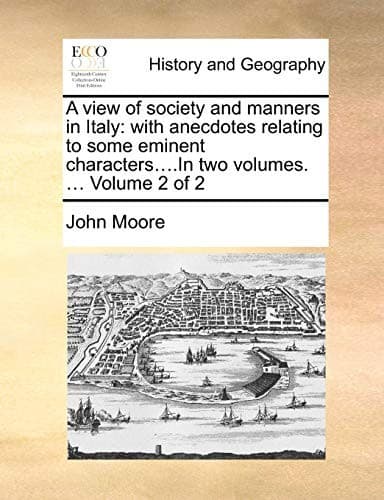
A View of Society and Manners in Italy, Volume 2 (of 2): With Anecdotes Relating to some Eminent CharactersMoore, John
History
A View of Society and Manners in Italy, Volume 2 (of 2): With Anecdotes Relating to some Eminent Characters
Moore, John
Italy -- Description and travel -- Early works to 1800; Italy -- Social life and customs -- Early works to 1800
his own name, and promote the interest of the Roman Catholic religion
in general, and that of the city of Rome in particular. He embraced
the favourable opportunity which the beginning of a century presented;
he invented a few extraordinary ceremonies, and declared the year 1300
the first jubilee year, during which he assured mankind, that heaven
would be in a particular manner propitious, in granting indulgences,
and remission of sins, to all who should come to Rome, and attend the
functions there to be performed, at this fortunate period, which was
not to occur again for a hundred years. This drew a great concourse of
wealthy sinners to Rome; and the extraordinary circulation of money it
occasioned, was strongly felt all over the Pope’s dominions. Clement the
Sixth, regretting that these advantages should occur so seldom, abridged
the period, and declared there would be a jubilee every fifty years; the
second was accordingly celebrated in the year 1350. Sixtus the Fifth,
imagining that the interval was still too long, once more retrenched the
half; and ever since there has been a jubilee every twenty-fifth year[2].
It is not likely that any future Pope will think of shortening this
period; if any alteration were again to take place, it most probably
would be, to restore the ancient period of fifty or a hundred years;
for, instead of the wealthy pilgrims who flocked to Rome from every
quarter of Christendom, ninety-nine in a hundred of those who come now,
are supported by alms during their journey, or are barely able to defray
their own expences by the strictest œconomy; and his Holiness is supposed
at present to derive no other advantage from the uncommon fatigue he is
obliged to go through on the jubilee year, except the satisfaction he
feels, in reflecting on the benefit his labours confer on the souls of
the beggars, and other travellers, who resort from all corners of Italy
to Rome, on this blessed occasion. The States which border on the Pope’s
dominions, suffer many temporal inconveniencies from the zeal of the
peasants and manufacturers, the greater part of whom still make a point
of visiting St. Peter’s on the jubilee year; the loss sustained by the
countries which such emigrants abandon, is not balanced by any advantage
transferred to that to which they resort; the good arising on the whole,
being entirely of a spiritual nature. By far the greater number of
pilgrims come from the kingdom of Naples, whose inhabitants are said
to be of a very devout and very amorous disposition. The first prompts
them to go to Rome in search of that absolution which the second renders
necessary; and on the year of jubilee, when indulgences are to be had at
an easier rate than at any other time, those who can afford it generally
carry away such a stock, as not only is sufficient to clear old scores,
but will also serve as an indemnifying fund for future transgressions.
Public-domain text, read in full here on John Shaqi.
Reviews
Reviews
No reviews yet
Be the first to share your thoughts on this work.
Join the Discussion
Join the discussion
Sign in to leave a comment or review.
Sign InorCreate an account