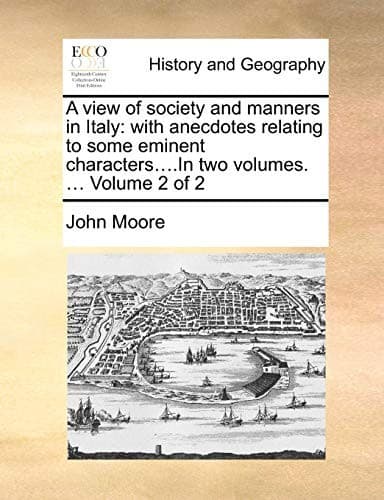
A View of Society and Manners in Italy, Volume 2 (of 2): With Anecdotes Relating to some Eminent CharactersMoore, John
History
A View of Society and Manners in Italy, Volume 2 (of 2): With Anecdotes Relating to some Eminent Characters
Moore, John
Italy -- Description and travel -- Early works to 1800; Italy -- Social life and customs -- Early works to 1800
Of all diadems, the Tiara, in my opinion, has the fewest charms; and
nothing can afford a stronger proof of the strength and perseverance of
man’s passion for sovereign power, than our knowledge, that even this
ecclesiastical crown is sought after with as much eagerness, perhaps
with more, than any other crown in the world, although the candidates
are generally in the decline of life, and all of a profession which
avows the most perfect contempt of worldly grandeur. This appears the
more wonderful when we reflect, that, over and above those sources
of weariness and vexation, which the Pope has in common with other
sovereigns, he has some which are peculiar to himself.—The tiresome
religious functions which he must perform, the ungenial solitude of
his meals, the exclusion of the company and conversation of women,
restriction from the tenderest and most delightful connexions in life,
from the endearments of a parent, and the _open acknowledgment_ of his
own children; his mind oppressed with the gloomy reflection, that the
man for whom he has the least regard, perhaps his greatest enemy, may
be his immediate successor; to which is added, the pain of seeing his
influence, both spiritual and temporal, declining every day; and the
mortification of knowing, that all his ancient lofty pretensions are
laughed at by one half of the Roman Catholics, all the Protestants, and
totally disregarded by the rest of mankind. I know of nothing which can
be put in the other scale to balance all those peculiar disadvantages
which his Holiness labours under, unless it is the singular felicity
which he lawfully may, and no doubt does enjoy, in the contemplation of
his own infallibility.
LETTER L.
Rome.
In their external deportment, the Italians have a grave solemnity of
manner, which is sometimes thought to arise from a natural gloominess of
disposition. The French, above all other nations, are apt to impute to
melancholy, the sedate serious air which accompanies reflection.
Though in the pulpit, on the theatre, and even in common conversation,
the Italians make use of a great deal of action; yet Italian vivacity is
different from French; the former proceeds from sensibility, the latter
from animal spirits.
Public-domain text, read in full here on John Shaqi.
Reviews
Reviews
No reviews yet
Be the first to share your thoughts on this work.
Join the Discussion
Join the discussion
Sign in to leave a comment or review.
Sign InorCreate an account