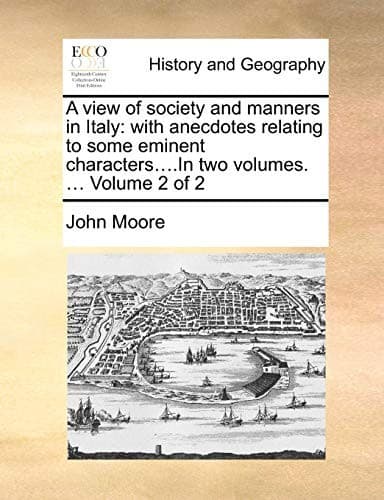
A View of Society and Manners in Italy, Volume 2 (of 2): With Anecdotes Relating to some Eminent CharactersMoore, John
History
A View of Society and Manners in Italy, Volume 2 (of 2): With Anecdotes Relating to some Eminent Characters
Moore, John
Italy -- Description and travel -- Early works to 1800; Italy -- Social life and customs -- Early works to 1800
The inhabitants of this country have not the brisk look, and elastic
trip, which is universal in France; they move rather with a flow
composed pace: their spines never having been forced into a straight
line, retain the natural bend; and the people of the most finished
fashion, as well as the neglected vulgar, seem to prefer the
unconstrained attitude of the Antinous, and other antique statues, to
the artificial graces of a French dancing-master, or the erect strut of
a German soldier. I imagine I perceive a great resemblance between many
of the living countenances I see daily, and the features of the ancient
busts and statues; which leads me to believe, that there are a greater
number of the genuine descendants of the old Romans in Italy, than is
generally imagined.
I am often struck with the fine character of countenance to be seen in
the streets of Rome. I never saw features more expressive of reflection,
sense, and genius; in the very lowest ranks there are countenances which
announce minds fit for the highest and most important situations; and we
cannot help regretting, that those to whom they belong, have not received
an education adequate to the natural abilities we are convinced they
possess, and placed where these abilities could be brought into action.
Of all the countries in Europe, Switzerland is that in which the
beauties of nature appear in the greatest variety of forms, and on the
most magnificent scale; in that country, therefore, the young landscape
painter has the best chance of seizing the most sublime ideas: but Italy
is the best school for the history painter, not only on account of its
being enriched with the works of the greatest masters, and the noblest
models of antique sculpture; but also on account of the fine expressive
style of the Italian countenance. Here you have few or none of those
fair, fat, glistening, unmeaning faces, so common in the more northern
parts of Europe. I happened once to sit by a foreigner of my acquaintance
at the Opera in the Hay-market, when a certain Nobleman, who at that time
was a good deal talked of, entered. I whispered him—“That is Lord ——.”
“Not surely the famous Lord ——,” said he. “Yes,” said I, “the very same.”
“It must be acknowledged then,” continued he, “that the noble Earl does
infinite honour to those who have had the care of his education.” “How
so?” rejoined I. “Because,” replied the foreigner, “a countenance so
completely vacant, strongly indicates a deficiency of natural abilities;
the respectable figure he makes in the senate, I therefore presume must
be entirely owing to instruction.”
Public-domain text, read in full here on John Shaqi.
Reviews
Reviews
No reviews yet
Be the first to share your thoughts on this work.
Join the Discussion
Join the discussion
Sign in to leave a comment or review.
Sign InorCreate an account