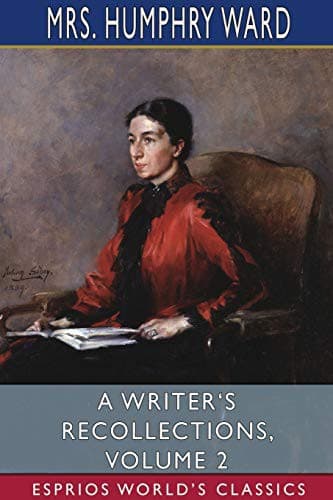
A Writer's Recollections — Volume 2Ward, Humphry, Mrs.
General
A Writer's Recollections — Volume 2
Ward, Humphry, Mrs.
Novelists, English -- 19th century -- Biography; Novelists, English -- 20th century -- Biography; Ward, Humphry, Mrs., 1851-1920
Produced by Andrew Templeton, Juliet Sutherland, David
Gundry, and the Project Gutenberg Online Distributed
Proofreading Team
A WRITER'S RECOLLECTIONS (IN TWO VOLUMES), VOLUME II
BY MRS. HUMPHRY WARD
Published November, 1918
[Illustration: HENRY JAMES]
CONTENTS
CHAPTER
I. LONDON IN THE 'EIGHTIES
II. LONDON FRIENDS
III. THE PUBLICATION OF "ROBERT ELSMERE"
IV. FIRST VISITS TO ITALY
V. AMALFI AND ROME. HAMPDEN AND "MARCELLA"
VI. "HELBECK OF BANNISDALE"
VII. THE VILLA BARBERINI. HENRY JAMES
VIII. ROMAN FRIENDS. "ELEANOR"
EPILOGUE
ILLUSTRATIONS
HENRY JAMES
ARTHUR BALFOUR
GOLDWIN SMITH
M. JUSSERAND
CHAPTER I
LONDON IN THE 'EIGHTIES
The few recollections of William Forster that I have put together in the
preceding volume lead naturally, perhaps, to some account of my
friendship and working relations at this time with Forster's most
formidable critic in the political press--Mr. John Morley, now Lord
Morley. It was in the late 'seventies, I think, that I first saw Mr.
Morley. I sat next him at the Master's dinner-table, and the impression
he made upon me was immediate and lasting. I trust that a great man, to
whom I owed much, will forgive me for dwelling on some of the incidents
of literary comradeship which followed!
My husband and I, on the way home, compared notes. We felt that we had
just been in contact with a singular personal power combined with a
moral atmosphere which had in it both the bracing and the charm that,
physically, are the gift of the heights. The "austere" Radical, indeed,
was there. With regard to certain vices and corruptions of our life and
politics, my uncle might as well have used Mr. Morley's name as that of
Mr. Frederick Harrison, when he presented us, in "Friendship's Garland,"
with Mr. Harrison setting up a guillotine in his back garden. There was
something--there always has been something--of the somber intensity of
the prophet in Mr. Morley. Burke drew, as we all remember, an
ineffaceable picture of Marie Antoinette's young beauty as he saw it in
1774, contrasting it with the "abominable scenes" amid which she
perished. Mr. Morley's comment is:
But did not the protracted agonies of a nation deserve the tribute
of a tear? As Paine asked, were men to weep over the plumage and
forget the dying bird? ... It was no idle abstraction, no
metaphysical right of man for which the French cried, but only the
practical right of being permitted, by their own toil, to save
themselves and the little ones about their knees from hunger and
cruel death.
Public-domain text, read in full here on John Shaqi.
Reviews
Reviews
No reviews yet
Be the first to share your thoughts on this work.
Join the Discussion
Join the discussion
Sign in to leave a comment or review.
Sign InorCreate an account