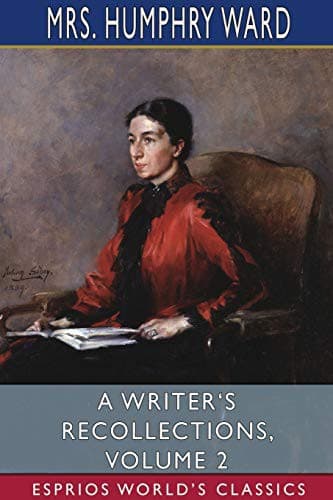
A Writer's Recollections — Volume 2Ward, Humphry, Mrs.
General
A Writer's Recollections — Volume 2
Ward, Humphry, Mrs.
Novelists, English -- 19th century -- Biography; Novelists, English -- 20th century -- Biography; Ward, Humphry, Mrs., 1851-1920
The cry of the poor, indeed, against the rich and tyrannous, the cry of
the persecuted Liberal, whether in politics or religion, against his
oppressors--it used to seem to me, in the 'eighties, when, to my
pleasure and profit, I was often associated with Mr. Morley, that in his
passionate response to this double appeal lay the driving impulse of his
life and the secret of his power over others. While we were still at
Oxford he had brought out most of his books: _On Compromise_--the fierce
and famous manifesto of 1874--and the well-known volumes on the
Encyclopedists, Voltaire, Rousseau, Diderot. It was not for nothing that
he had been a member of Pattison's college; and a follower of John
Stuart Mill. The will to look the grimmest facts of life and destiny in
the face, without flinching, and the resolve to accept no "anodyne" from
religion or philosophy, combined with a ceaseless interest in the human
fate and the human story, and a natural, inbred sympathy for the many
against the few, for the unfortunate against the prosperous; it was
these ardors and the burning sincerity with which he felt them, that
made him so great a power among us, his juniors by half a generation. I
shall never lose the impression that _Compromise_, with its almost
savage appeal for sincerity in word and deed, made upon me--an
impression which had its share in _Robert Elsmere_.
But together with this tragic strenuousness there was always the
personal magic which winged it and gave it power. Mr. Morley has known
all through his life what it was to be courted, by men and women alike,
for the mere pleasure of his company; in which he resembled another man
whom both he and I knew well--Sir Alfred Lyall. It is well known that
Mr. Gladstone was fascinated by the combination in his future biographer
of the Puritan, the man of iron conviction, and the delightful man of
letters. And in my own small sphere I realized both aspects of Mr.
Morley during the 'eighties. Just before we left Oxford I had begun to
write reviews and occasional notes for the _Pall Mall_, which he was
then editing; after we settled in London, and he had become also editor
of _Macmillan_, he asked me, to my no little conceit, to write a monthly
_causerie_ on a book or books for that magazine. I never succeeded in
writing nearly so many; but in two years I contributed perhaps eight or
ten papers--until I became absorbed in _Robert Elsmere_ and Mr. Morley
gave up journalism for politics. During that time my pleasant task
brought me into frequent contact with my editor. Nothing could have been
kinder than his letters; at the same time there was scarcely one of them
that did not convey some hint, some touch of the critical goad,
invaluable to the recipient. I wrote him a letter of wailing when he
gave up the editorship and literature and became Member for Newcastle.
Such a fall it seemed to me then! But Mr. Morley took it patiently. "Do
not lament over your friend, but pray for him!" As, indeed, one might
Public-domain text, read in full here on John Shaqi.
Reviews
Reviews
No reviews yet
Be the first to share your thoughts on this work.
Join the Discussion
Join the discussion
Sign in to leave a comment or review.
Sign InorCreate an account