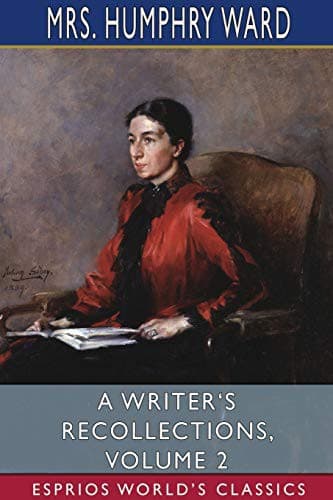
A Writer's Recollections — Volume 2Ward, Humphry, Mrs.
General
A Writer's Recollections — Volume 2
Ward, Humphry, Mrs.
Novelists, English -- 19th century -- Biography; Novelists, English -- 20th century -- Biography; Ward, Humphry, Mrs., 1851-1920
As to his generosity and kindness toward younger students, it was
endless. I asked him once, when I was writing for _Macmillan_, to give
me some suggestions for an article on Chateaubriand. The letter I
received from him the following morning is a marvel of knowledge,
bibliography, and kindness. And not only did he give me such a "scheme"
of reading as would have taken any ordinary person months to get
through, but he arrived the following day in a hansom, with a number of
the books he had named, and for a long time they lived on my shelves.
Alack! I never wrote the article, but when I came to the writing of
_Eleanor_, for which certain material was drawn from the life of
Chateaubriand, his advice helped me. And I don't think he would have
thought it thrown away. He never despised novels!
Once on a visit to us at Stocks, there were nine books of different
sorts in his room which I had chosen and placed there. By Monday morning
he had read them all. His library, when he died, contained about 60,000
volumes--all read; and it will be remembered that Lord Morley, to whom
Mr. Carnegie gave it, has handed it on to the University of Cambridge.
In 1884, when I first knew him, however, Lord Acton was every bit as
keen a politician as he was a scholar. As is well known, he was a poor
speaker, and never made any success in Parliament; and this was always,
it seemed to me, the drop of gall in his otherwise happy and
distinguished lot. But if he was never in an English Cabinet, his
influence over Mr. Gladstone through the whole of the Home Rule struggle
gave him very real political power. He and Mr. Morley were the constant
friends and associates to whom Mr. Gladstone turned through all that
critical time. But the great split was rushing on, and it was also in
1884 that, at Admiral Maxse's one night at dinner, I first saw Mr.
Chamberlain, who was to play so great a part in the following years. It
was a memorable evening to me, for the other guest in a small party was
M. Clémenceau.
M. Clémenceau was then at the height of his power as the maker and
unmaker of French Ministries. It was he more than any other single man
who had checkmated the Royalist reaction of 1877 and driven MacMahon
from power; and in the year after we first met him he was to bring Jules
Ferry to grief over _L'affaire de Tongkin_. He was then in the prime of
life, and he is still (1917), thirty-three years later,[1] one of the
most vigorous of French political influences. Mr. Chamberlain, in 1884,
was forty-eight, five years older than the French politician, and was at
that time, of course, the leader of the Radicals, as distinguished from
the old Liberals, both in the House of Commons and Mr. Gladstone's Cabinet.
Public-domain text, read in full here on John Shaqi.
Reviews
Reviews
No reviews yet
Be the first to share your thoughts on this work.
Join the Discussion
Join the discussion
Sign in to leave a comment or review.
Sign InorCreate an account