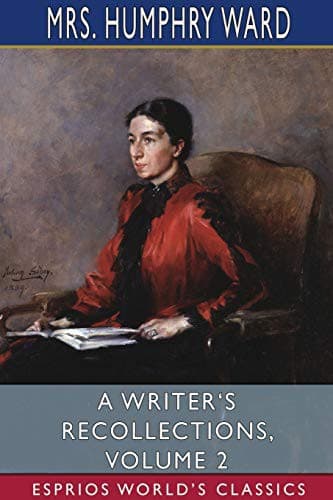
A Writer's Recollections — Volume 2Ward, Humphry, Mrs.
General
A Writer's Recollections — Volume 2
Ward, Humphry, Mrs.
Novelists, English -- 19th century -- Biography; Novelists, English -- 20th century -- Biography; Ward, Humphry, Mrs., 1851-1920
How many great events, in which those two men were to be concerned, were
still in the "abysm of time," as we sat listening to them at Admiral
Maxse's dinner-table!--Clémenceau, the younger, and the more fiery and
fluent; Chamberlain, with no graces of conversation, and much less ready
than the man he was talking with, but producing already the impression
of a power, certain to leave its mark, if the man lived, on English
history. In a letter to my father after the dinner-party, I described
the interest we had both felt in M. Clémenceau. "Yet he seems to me a
light weight to ride such a horse as the French democracy!"
[Footnote 1: These lines were written shortly before, on the overthrow
of M. Panlevé. M. Clémenceau, at the age of seventy-seven, became Prime
Minister of France, at what may well be the deciding moment of French
destiny (January, 1918).]
In the following year, 1885, I remember a long conversation on the
Gordon catastrophe with Mr. Chamberlain at Lady Jeune's. It was evident,
I thought, that his mind was greatly exercised by the whole story of
that disastrous event. He went through it from step to step, ending up
deliberately, but with a sigh, "I have never been able to see, from day
to day, and I do not see now, how the Ministry could have taken any
other course than that they did take."
Yet the recently published biography of Sir Charles Dilke shows clearly
how very critical Mr. Chamberlain had already become of his great
leader, Mr. Gladstone, and how many causes were already preparing the
rupture of 1886.
* * * * *
I first met Mr. Browning in 1884 or 1885, if I remember right, at a
Kensington dinner-party, where he took me down. A man who talked loud and
much was discoursing on the other side of the table; and a spirit of
opposition had clearly entered into Mr. Browning.
_À propos_ of some recent acting in London we began to talk of Molière,
and presently, as though to shut out the stream of words opposite, which
was damping conversation, the old poet--how the splendid brow and the
white hair come back to me!--fell to quoting from the famous sonnet
scene in "Le Misanthrope": first of all, Alceste's rage with Phillinte's
flattery of the wretched verses declaimed by Oronte--"_Morbleu! vil
complaisant, vous louez des sottises_"; then the admirable fencing
between Oronte and Alceste, where Alceste at first tries to convey his
contempt for Oronte's sonnet indirectly, and then bursts out:
"_Ce n'est que jeu de mots, qu'affectation pure,
Et ce n'est point ainsi que parle la nature_!"
breaking immediately into the _vieille chanson_, one line of which is
worth all the affected stuff that Célimène and her circle admire.
Public-domain text, read in full here on John Shaqi.
Reviews
Reviews
No reviews yet
Be the first to share your thoughts on this work.
Join the Discussion
Join the discussion
Sign in to leave a comment or review.
Sign InorCreate an account