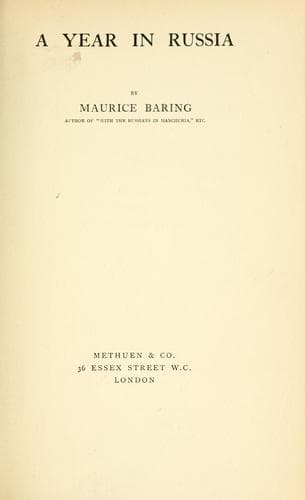
Russia -- History -- Revolution, 1905-1907; Russia -- Politics and government -- 1894-1917; Russia -- Social conditions -- 1801-1917
Let us take first the abolition of capital punishment. People say: “They
are asking for the abolition of capital punishment in Russia, whereas in
an enlightened country like ours we hang women. It is absurd.” Now,
capital punishment, except for regicides, was abolished in Russia by the
Empress Elizabeth in 1753; and it has only been applied lately in virtue
of martial law. If you committed an ordinary murder in Russia you were
put in prison for a certain number of years, often not for a very long
period. Ordinary murders did not increase in consequence, and the
Russians were satisfied with this detail of their legislation. Now,
since the revolutionary movement began last year, and more especially
since the prevalence of martial law in many districts, what has happened
is this: that whereas capital punishment was still in abeyance in
respect to ordinary criminals, it obtained as far as political offenders
were concerned. It is objected, of course, that people who throw bombs
must expect to be killed and that the murder of innocent policemen is
wholly unjustifiable. But the other side rejoins as follows: “What is
terrorism but the inevitable result of the continued lawlessness of the
local authorities representing the Government?” While admitting to the
full that it is deplorable, how can one expect it to diminish as long as
the Government continues to condone guilty officials, or only punishes
them in a ludicrously inadequate manner? It is here that the
Government’s case breaks down. A man who kills a policeman is, if he is
caught, at least certain of punishment, but if a police officer walks
into a house and kills, as Ermolov did in Moscow, an utterly inoffensive
doctor, he is certain to be let off (Ermolov was sentenced to
deprivation of military rank and a short term of imprisonment). That is
what the Liberals complain of, pointing at the same time to utterly
indiscriminate executions carried out under martial law by generals in
Moscow, in the Baltic provinces, and in Siberia. I cannot say that I
think their position is wildly unreasonable. The Government’s argument
is exceedingly specious, and it is the easiest thing in the world to
convince any Englishman of its soundness, only it omits half the truth
and the whole cause of the agitation.
The same thing can be said about the demand for amnesty. People in
England think that the Duma is clamouring exclusively for the release of
murderers. The fact is that, as I have said before, the proportion of
murderers in prison is small. The bomb-throwers nearly always escape or
are killed, whereas the prisons are packed with people who are there by
chance and against whom there is not even any accusation.
Public-domain text, read in full here on John Shaqi.
Reviews
Reviews
No reviews yet
Be the first to share your thoughts on this work.
Elsewhere in the archive
Join the Discussion
Join the discussion
Sign in to leave a comment or review.
Sign InorCreate an account