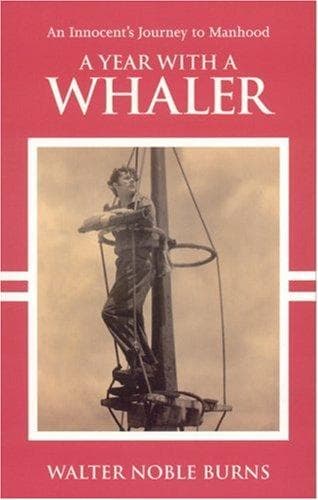
Alexander (Brig); Burns, Walter Noble, 1872-1932 -- Voyages and travels; Whalers (Persons) -- United States -- Biography; Whaling
Working night and day, it took three days to cut in and try out the whale.
While the work was going on, the decks were so greasy that we could run
and slide anywhere for long distances like boys on ice. After the whale
had been tried out and the oil casks had been stowed below, we fell upon
the decks and paint work with lye and water. Hard work soon had the ship
looking as bright as a new pin.
CHAPTER XIII
SHAKING HANDS WITH SIBERIA
The ship's prow was turned northward after work on the whale had been
finished. I expected we would soon run into the ice again. We sailed
on and on, but not a block of ice big enough to make a highball did we
sight. The white floes and drifts and the frozen continent floating
southward, along the coasts of which we had cruised for whales and which
had surrounded us and held us captive for three weeks, had disappeared
entirely. The warm water from the south, the southern winds, and the
spring sunshine had melted the ice. Its utter disappearance savored of
magic.
A long hilly coast rose ahead of us covered with grass, barren of trees or
shrubs, dotted with blackened skeletons of old ice--an utterly desolate
land. It was Siberia. We put into a bight called St. Lawrence Bay.
There was an Eskimo village on the shore. The huts were made of whale
ribs covered with hides of walrus and reindeer. In the warm weather,
some of the hides had been removed and we saw the white gleaming bones
of the frame work. We could see the dogs with tails curling over their
backs frisking about and could hear their clamor as they bayed the great
white-winged thing that had come up from over the sea's verge.
In this first part of July it was continuous day. The sun set at eleven
o'clock at night in the northwest. Its disc remained barely below the
horizon--we could almost see its flaming rim. A molten glow of color made
the sky resplendent just above it as it passed across the north pole. It
rose at 1:30 in the morning high in the northeast. All the time it was
down a brilliant twilight prevailed--a twilight like that which in our
temperate zone immediately follows the sinking of the sun behind a hill.
We could see to read without difficulty.
Soon boats and kyacks were putting off from the village. When we were
still a mile or two out, strange craft came alongside and Eskimo men,
women, and children swarmed aboard. Very picturesque they looked in
clothes made of the skins of reindeer, hair seals, dogs, and squirrels,
oddly trimmed and decorated with fur mosaics in queer designs. Some of
the women wore over their furs a yellow water-proof cloak made of the
intestines of fish, ornamented with needle-work figures and quite neat
looking.
The men and the older women had animal faces of low intelligence. The
young girls were extremely pretty, with glossy, coal-black hair, bright
black eyes, red cheeks, lips like ripe cherries, and gleaming white teeth
forever showing in the laughter of irresponsibility and perfect health.
Public-domain text, read in full here on John Shaqi.
Reviews
Reviews
No reviews yet
Be the first to share your thoughts on this work.
Join the Discussion
Join the discussion
Sign in to leave a comment or review.
Sign InorCreate an account