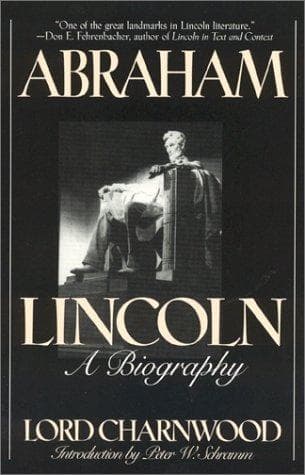
Abraham LincolnCharnwood, Godfrey Rathbone Benson, Baron
History
Abraham Lincoln
Charnwood, Godfrey Rathbone Benson, Baron
Lincoln, Abraham, 1809-1865; Presidents -- United States -- Biography
accepting their advice most submissively and sometimes disregarding it
wholly. One said it was "ahead of its time," another that it was a
"damned fool utterance." All more or less strongly condemned it,
except this time Herndon, who, according to his recollection, said, "It
will make you President." He listened to all and then addressed them,
we are told, substantially as follows: "Friends, this thing has been
retarded long enough. The time has come when these sentiments should
be uttered; and if it is decreed that I should go down because of this
speech, then let me go down linked to the truth--let me die in the
advocacy of what is just and right." Rather a memorable pronouncement
of a candidate to his committee; and the man who records it is
insistent upon every little illustration he can find both of Lincoln's
cunning and of his ambition.
Lincoln did go down in this particular contest. Many friends wrote and
reproved him after this "damned fool utterance," but his defeat was
not, after all, attributed to that. All the same he did himself assure
his defeat, and he did it with extraordinary skill, for the purpose of
ensuring that the next President should be a Republican President,
though it is impossible he should at that time have counted upon being
himself that Republican. Each candidate had undertaken to answer set
questions which his opponent might propound to him. And great public
attention was paid to the answers to these interrogatories. The Dred
Scott judgments created a great difficulty for Douglas; he was bound to
treat them as right; but if they were right and Congress had no power
to prohibit slavery in a Territory, neither could a Territorial
Legislature with authority delegated by Congress have that power; and,
if this were made clear, it would seem there was an end of that free
choice of the people in the Territories of which Douglas had been the
great advocate. Douglas would use all his evasive skill in keeping
away from this difficult point. If, however, he could be forced to
face it Lincoln knew what he would say. He would say that slavery
would not be actually unlawful in a Territory, but would never actually
exist in it if the Territorial Legislature chose to abstain, as it
could, from passing any of the laws which would in practice be
necessary to protect slave property. By advocating this view Douglas
would fully reassure those of his former supporters in Illinois who
puzzled themselves on the Dred Scott case, but he would infuriate the
South. Lincoln determined to force Douglas into this position by the
questions which he challenged him to answer. When he told his friends
of his ambition, they all told him he would lose his election.
"Gentlemen," said Lincoln, "I am killing larger game; if Douglas
answers, he can never be President, and the battle of 1860 is worth a
hundred of this." The South was already angry with Douglas for his
action over the Kansas Constitution, but he would have been an
Public-domain text, read in full here on John Shaqi.
Reviews
Reviews
No reviews yet
Be the first to share your thoughts on this work.
Elsewhere in the archive
Join the Discussion
Join the discussion
Sign in to leave a comment or review.
Sign InorCreate an account