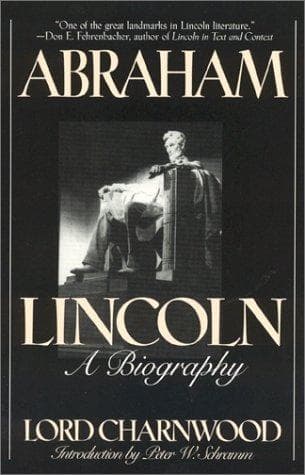
Abraham LincolnCharnwood, Godfrey Rathbone Benson, Baron
History
Abraham Lincoln
Charnwood, Godfrey Rathbone Benson, Baron
Lincoln, Abraham, 1809-1865; Presidents -- United States -- Biography
It is impossible to avoid asking whether on this question of
constitutional law the Northern opinion or the Southern opinion was
correct. (The question was indeed an important question in determining
the proper course of procedure for a President when confronted with
secession, but it must be protested that the moral right and political
wisdom of neither party in the war depended mainly, if at all, upon this
legal point. It was a question of the construction which a court of law
should put upon a document which was not drawn up with any view to
determining this point.) If we go behind the Constitution, which was
then and is now in force, to the original document of which it took the
place, we shall find it entitled "Articles of Confederation and Perpetual
Union," but we shall not find any such provisions as men desirous of
creating a stable and permanent federal government might have been
expected to frame. If we read the actual Constitution we shall find no
word distinctly implying that a State could or could not secede. As to
the real intention of its chief authors, there can be no doubt that they
hoped and trusted the Union would prove indissoluble, and equally little
doubt that they did not wish to obtrude upon those whom they asked to
enter into it the thought that this step would be irrevocable. For the
view taken in the South there is one really powerful argument, on which
Jefferson Davis insisted passionately in the argumentative memoirs with
which he solaced himself in old age. It is that in several of the
States, when the Constitution was accepted, public declarations were made
to the citizens of those States by their own representatives that a State
might withdraw from the Union. But this is far from conclusive. No man
gets rid of the obligation of a bond by telling a witness that he does
not mean to be bound; the question is not what he means, but what the
party with whom he deals must naturally take him to mean. Now the
Constitution of the United States upon the face of it purports to create
a government able to take its place among the other governments of the
world, able if it declares war to wield the whole force of its country in
that war, and able if it makes peace to impose that peace upon all its
subjects. This seems to imply that the authority of that government over
part of the country should be legally indefeasible. It would have been
ridiculous if, during a war with Great Britain, States on the Canadian
border should have had the legal right to secede, and set up a neutral
government with a view to subsequent reunion with Great Britain. The
sound legal view of this matter would seem to be: that the doctrine of
secession is so repugnant to the primary intention with which the
national instrument of government was framed that it could only have been
supported by an express reservation of the right to secede in the
Constitution itself.
Public-domain text, read in full here on John Shaqi.
Reviews
Reviews
No reviews yet
Be the first to share your thoughts on this work.
Elsewhere in the archive
Join the Discussion
Join the discussion
Sign in to leave a comment or review.
Sign InorCreate an account