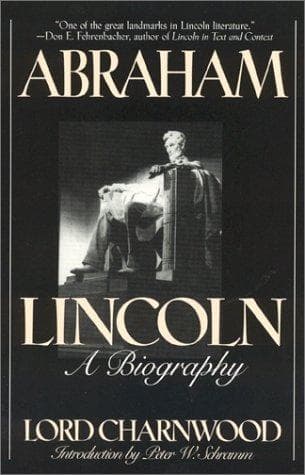
Abraham LincolnCharnwood, Godfrey Rathbone Benson, Baron
History
Abraham Lincoln
Charnwood, Godfrey Rathbone Benson, Baron
Lincoln, Abraham, 1809-1865; Presidents -- United States -- Biography
The Colonies, however, backed up by the British Government with the
vigour which Chatham imparted to it, had acted together against a common
danger from the French. When the States, as we must now call them, acted
together against the British Government they did so in name as "United
States," and they shortly proceeded to draw up "Articles of Confederation
and Perpetual Union." But it was union of a feeble kind. The separate
government of each State, in its internal affairs, was easy to provide
for; representative institutions always existed, and no more change was
needed than to substitute elected officers for the Governors and
Councillors formerly appointed by the Crown. For the Union a Congress
was provided which was to represent all the States in dealings with the
outside world, but it was a Government with no effective powers except
such as each separate State might independently choose to lend it. It
might wage war with England, but it could not effectually control or
regularly pay the military service of its own citizens; it might make a
treaty of peace with England, but it could not enforce on its citizens
distasteful obligations of that treaty. Such an ill-devised machine
would have worked well enough for a time, if the Union Government could
have attached to itself popular sentiments of honour and loyalty. But
the sentiments were not there; and it worked badly.
When once we were reconciled to a defeat which proved good for us, it
became a tradition among English writers to venerate the American
Revolution. Later English historians have revolted from this
indiscriminate veneration. They insist on another side of the facts: on
the hopelessness of the American cause but for the commanding genius of
Washington and his moral authority, and for the command which France and
Spain obtained of the seas; on the petty quarrelsomeness with which the
rights of the Colonists were urged, and the meanly skilful agitation
which forced on the final rupture; on the lack of sustained patriotic
effort during the war; on the base cruelty and dishonesty with which the
loyal minority were persecuted and the private rights guaranteed by the
peace ignored. It does not concern us to ascertain the precise justice
in this displeasing picture; no man now regrets the main result of the
Revolution, and we know that a new country is a new country, and that
there was much in the circumstances of the war to encourage indiscipline
and ferocity. But the fact that there is cause for such an indictment
bears in two ways upon our present subject.
Public-domain text, read in full here on John Shaqi.
Reviews
Reviews
No reviews yet
Be the first to share your thoughts on this work.
Join the Discussion
Join the discussion
Sign in to leave a comment or review.
Sign InorCreate an account