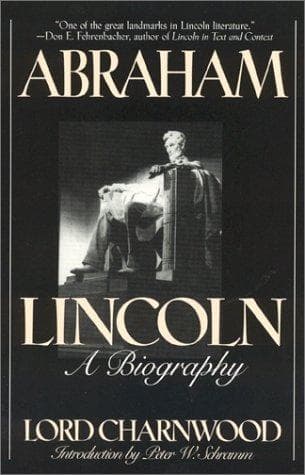
Abraham LincolnCharnwood, Godfrey Rathbone Benson, Baron
History
Abraham Lincoln
Charnwood, Godfrey Rathbone Benson, Baron
Lincoln, Abraham, 1809-1865; Presidents -- United States -- Biography
reason to doubt that he acted on his own sober judgment as well as that
of his Cabinet. Whatever degree of confidence he reposed in Scott,
Scott was not very insistent; the risk was not overwhelming; the battle
was very nearly won, would have been won if the orders of Scott had
been carried out. No very great harm in fact followed the defeat of
Bull Run; and the danger of inaction was real. He was probably then,
as he certainly was afterwards, profoundly afraid that the excessive
military caution which he often encountered would destroy the cause of
the North by disheartening the people who supported the war. That is
no doubt a kind of fear to which many statesmen are too prone, but
Lincoln's sense of real popular feeling throughout the wide extent of
the North is agreed to have been uncommonly sure. Definite judgment on
such a question is impossible, but probably Lincoln and his Cabinet
were wise.
However, they did not win their battle. The Southern army under
Beauregard lay near the Bull Run river, some twenty miles from
Washington, covering the railway junction of Manassas on the line to
Richmond. The main Northern army, under General McDowell, a capable
officer, lay south of the Potomac, where fortifications to guard
Washington had already been erected on Virginian soil. In the
Shenandoah Valley was another Southern force, under Joseph Johnston,
watched by the Northern general Patterson at Harper's Ferry, which had
been recovered by Scott's operations. Each of these Northern generals
was in superior force to his opponent. McDowell was to attack the
Confederate position at Manassas, while Patterson, whose numbers were
nearly double Johnston's, was to keep him so seriously occupied that he
could not join Beauregard. With whatever excuse of misunderstanding or
the like, Patterson made hardly an attempt to carry out his part of
Scott's orders, and Johnston, with the bulk of his force, succeeded in
joining Beauregard the day before McDowell's attack, and without his
gaining knowledge of this movement. The battle of Bull Run or Manassas
(or rather the earlier and more famous of two battles so named) was an
engagement of untrained troops in which up to a certain point the high
individual quality of those troops supplied the place of discipline.
McDowell handled with good judgment a very unhandy instrument. It was
only since his advance had been contemplated that his army had been
organised in brigades. The enemy, occupying high wooded banks on the
south side of the Bull Run, a stream about as broad as the Thames at
Oxford but fordable, was successfully pushed back to a high ridge
beyond; but the stubborn attacks over difficult ground upon this
further position failed from lack of co-ordination, and, when it
already seemed doubtful whether the tired soldiers of the North could
renew them with any hope, they were themselves attacked on their right
flank. It seems that from that moment their success upon that day was
Public-domain text, read in full here on John Shaqi.
Reviews
Reviews
No reviews yet
Be the first to share your thoughts on this work.
Elsewhere in the archive
Join the Discussion
Join the discussion
Sign in to leave a comment or review.
Sign InorCreate an account