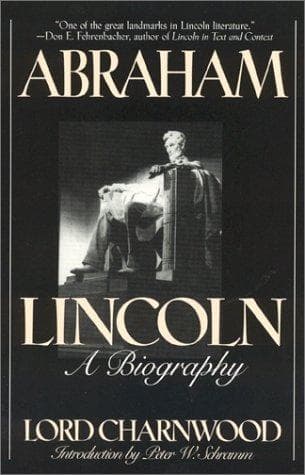
Abraham LincolnCharnwood, Godfrey Rathbone Benson, Baron
History
Abraham Lincoln
Charnwood, Godfrey Rathbone Benson, Baron
Lincoln, Abraham, 1809-1865; Presidents -- United States -- Biography
It is perhaps not very commonly understood that President and Congress
alike are as strictly fettered in their action by the Constitution as a
limited liability company is by its Memorandum of Association. This
Constitution, which defines both the form of government and certain
liberties of the subject, is not unalterable, but it can be altered only
by a process which requires both the consent of a great majority in
Congress or alternatively of a great majority of the legislatures of the
distinct States composing the Union, and also ratification of amendments
by three-fourths of the several States. Thus we shall have to notice
later that a "Constitutional Amendment" abolishing slavery became a
terror of the future to many people in the slave States, but remained all
the time an impossibility in the view of most people in the free States.
We have, above all things, to dismiss from our minds any idea that the
Legislature of a State is subordinate to the Congress of the United
States, or that a State Governor is an officer under the President. The
Constitution of the Union was the product of a half-developed sense of
nationality. Under it the State authority (in the American sense of
"State") and the Union or Federal authority go on side by side working in
separate spheres, each subject to Constitutional restrictions, but each
in its own sphere supreme. Thus the State authority is powerless to make
peace or war or to impose customs duties, for those are Federal matters.
But the Union authority is equally powerless, wherever a State authority
has been constituted, to punish ordinary crime, to promote education, or
to regulate factories. In particular, by the Constitution as it stood
till after the Civil War, the Union authority was able to prohibit the
importation of slaves from abroad after the end of 1807, but had no power
to abolish slavery itself in any of the States.
Further, Congress had to be constituted in such a manner as to be
agreeable to the smaller States which did not wish to enter into a Union
in which their influence would be swamped by their more populous
neighbours. Their interest was secured by providing that in the Senate
each State should have two members and no more, while in the House of
Representatives the people of the whole Union are represented according
to population. Thus legislation through Congress requires the
concurrence of two forces which may easily be opposed, that of the
majority of American citizens and that of the majority of the several
States. Of the two chambers, the Senate, whose members are elected for
six years, and to secure continuity do not all retire at the same time,
became as time went on, though not at first, attractive to statesmen of
position, and acquired therefore additional influence.
Public-domain text, read in full here on John Shaqi.
Reviews
Reviews
No reviews yet
Be the first to share your thoughts on this work.
Join the Discussion
Join the discussion
Sign in to leave a comment or review.
Sign InorCreate an account