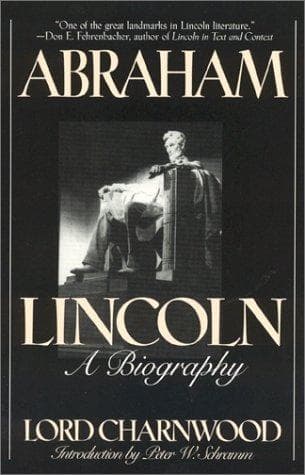
Abraham LincolnCharnwood, Godfrey Rathbone Benson, Baron
History
Abraham Lincoln
Charnwood, Godfrey Rathbone Benson, Baron
Lincoln, Abraham, 1809-1865; Presidents -- United States -- Biography
The makers of the Constitution earned in a manner the full praise that
has ever since been bestowed on them. But they did not, as it has often
been suggested they did, create a sort of archetype and pattern for all
Governments that may hereafter partake of a federal character. Nor has
the curious machine which they devised--with its balanced opposition
between two legislative chambers, between the whole Legislature and the
independent executive power of the President, between the governing power
of the moment and the permanent expression of the people's will embodied
in certain almost unalterable laws--worked conspicuously better than
other political constitutions. The American Constitution owes its
peculiarities partly to the form which the State Governments had
naturally taken, and partly to sheer misunderstanding of the British
Constitution, but much more to the want at the time of any strong sense
of national unity and to the existence of a good deal of dislike to all
government whatsoever. The sufficient merit of its founders was that of
patient and skilful diplomatists, who, undeterred by difficulties, found
out the most satisfactory settlement that had a chance of being accepted
by the States.
So the Colonies, which in 1776 had declared their independence of Great
Britain under the name of the United States of America, entered in 1789
into the possession of machinery of government under which their unity
and independence could be maintained.
It will be well at once to describe those features of the Constitution
which it will be necessary for us later to bear in mind. It is generally
known that the President of the United States is an elected
officer--elected by what operates, though intended to act otherwise, as a
popular vote. During the four years of his office he might roughly be
said to combine the functions of the King in this country and those of a
Prime Minister whose cabinet is in due subjection to him. But that
description needs one very important qualification. He wields, with
certain slight restrictions, the whole executive power of government, but
neither he nor any of his ministers can, like the ministers of our King,
sit or speak in the Legislature, nor can he, like our King, dissolve that
Legislature. He has indeed a veto on Acts of Congress, which can only be
overridden by a large majority in both Houses. But the executive and the
legislative powers in America were purposely so constituted as to be
independent of each other to a degree which is unknown in this country.
Public-domain text, read in full here on John Shaqi.
Reviews
Reviews
No reviews yet
Be the first to share your thoughts on this work.
Join the Discussion
Join the discussion
Sign in to leave a comment or review.
Sign InorCreate an account