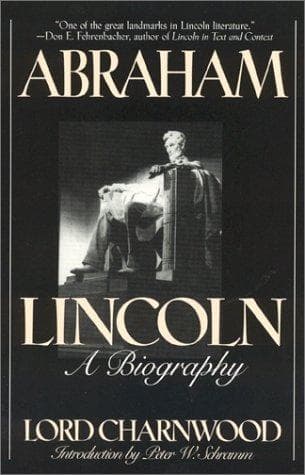
Abraham LincolnCharnwood, Godfrey Rathbone Benson, Baron
History
Abraham Lincoln
Charnwood, Godfrey Rathbone Benson, Baron
Lincoln, Abraham, 1809-1865; Presidents -- United States -- Biography
Some of his reasons for waiting were very plain. He was not going to
take action on the alleged ground of military necessity till he was
sure that the necessity existed. Nor was he going to take it till it
would actually lead to the emancipation of a great number of slaves.
Above all, he would not act till he felt that the North generally would
sustain his action, for he knew, better than Congressmen who judged
from their own friends in their own constituencies, how doubtful a
large part of Northern opinion really was. We have seen how in the
summer of 1861 he felt bound to disappoint the advanced opinion which
supported Fremont. He continued for more than a year after in a course
which alienated from himself the confidence of the men with whom he had
most sympathy. He did this deliberately rather than imperil the
unanimity with which the North supported the war. There was indeed
grave danger of splitting the North in two if he appeared unnecessarily
to change the issue from Union to Liberation. We have to remember that
in all the Northern States the right of the Southern States to choose
for themselves about slavery had been fully admitted, and that four of
the Northern States were themselves slave States all this while.
But this is not the whole explanation of his delay. It is certain that
apart from this danger he would at first rather not have played the
historic part which he did play as the liberator of the slaves, if he
could have succeeded in the more modest part of encouraging a process
of gradual emancipation. In his Annual Message to Congress in
December, 1861, he laid down the general principles of his policy in
this matter. He gave warning in advance to the Democrats of the North,
who were against all interference with Southern institutions, that
"radical and extreme measures" might become indispensable to military
success, and if indispensable would be taken; but he declared his
anxiety that if possible the conflict with the South should not
"degenerate into a violent and remorseless revolutionary struggle," for
he looked forward with fear to a complete overturning of the social
system of the South. He feared it not only for the white people but
also for the black. "Gradual and not sudden emancipation," he said, in
a later Message, "is better for all." It is now probable that he was
right, and yet it is difficult not to sympathise with the earnest
Republicans who were impatient at his delay, who were puzzled and
pained by the free and easy way in which in grave conversation he would
allude to "the nigger question," and who concluded that "the President
is not with us; has no sound Anti-slavery sentiment." Indeed, his
sentiment did differ from theirs. Certainly, he hated slavery, for he
had contended more stubbornly than any other man against any concession
which seemed to him to perpetuate slavery by stamping it with approval;
but his hatred of it left him quite without the passion of moral
Public-domain text, read in full here on John Shaqi.
Reviews
Reviews
No reviews yet
Be the first to share your thoughts on this work.
Elsewhere in the archive
Join the Discussion
Join the discussion
Sign in to leave a comment or review.
Sign InorCreate an account